Measuring Success in Generative Search: The Evolution of GEO Evaluation Metrics and Benchmarks
Measuring Success in Generative Search: The Evolution of GEO Evaluation Metrics and Benchmarks
The shift from traditional search engines to generative AI systems represents more than a change in user interface—it represents a fundamental transformation in how we measure content visibility and success. Traditional SEO metrics like page rankings, click-through rates, and organic traffic become less meaningful when AI systems provide direct answers without requiring users to click through to source websites. Recent research has introduced sophisticated evaluation frameworks and benchmarks specifically designed for Generative Engine Optimization (GEO), providing systematic approaches to measuring success in AI-powered search. This analysis examines the evolution of evaluation metrics and the development of specialized benchmarks that enable evidence-based GEO strategy.
The Measurement Challenge: Why Traditional Metrics Fail
Traditional SEO metrics were designed for a specific user journey: users enter queries, search engines provide ranked lists of links, users click through to websites, and success is measured through rankings, clicks, and conversions.
This model breaks down with generative engines:
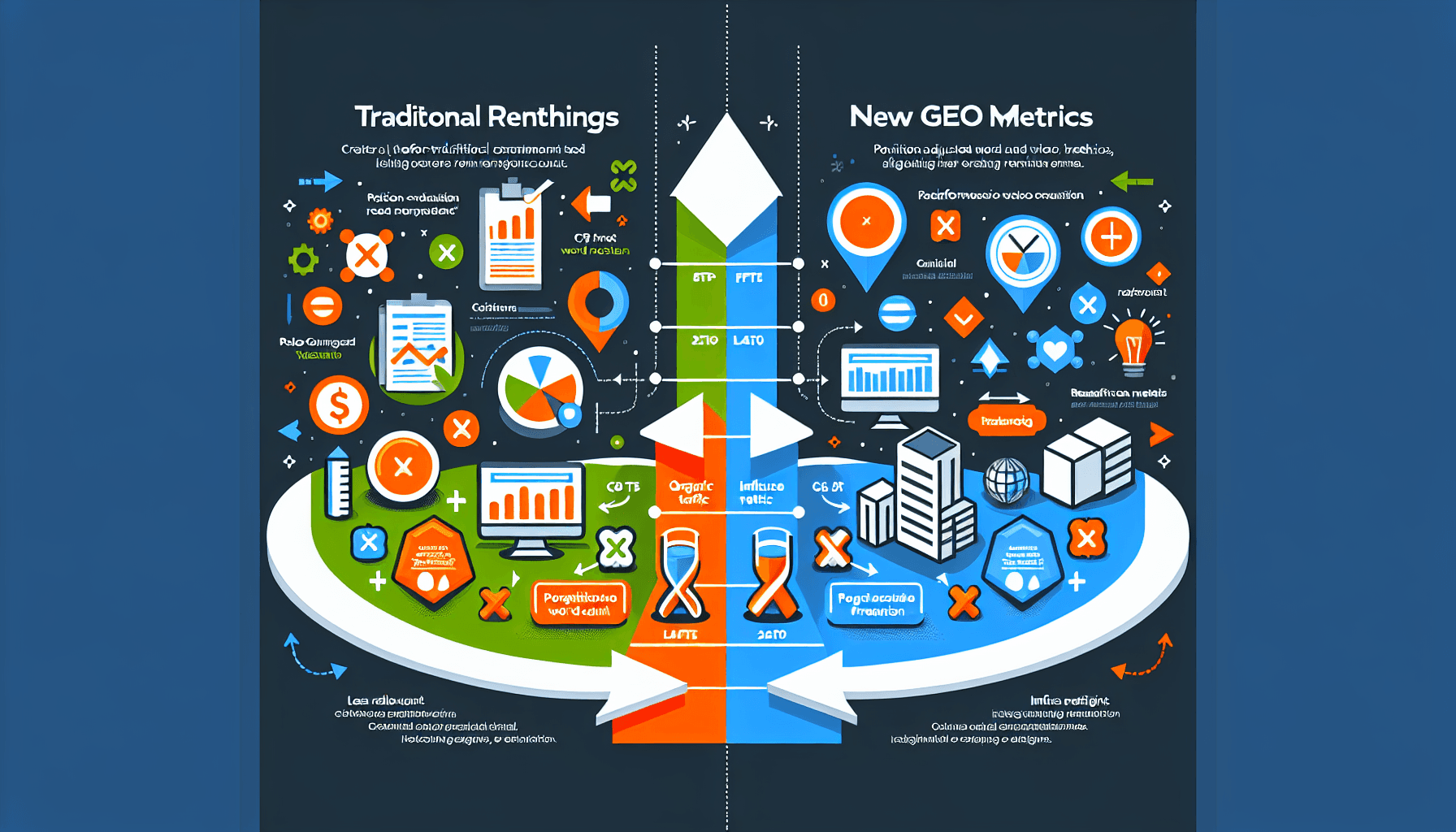
Traditional Metrics and Their Limitations
Page Rankings: Traditional search engines provide numbered positions (rank 1, rank 2, etc.). Generative engines synthesize information from multiple sources without explicit rankings, making position metrics meaningless.
Click-Through Rate (CTR): Success in traditional SEO is measured by the percentage of users who click on your link. Generative engines often provide complete answers without requiring clicks, making CTR an unreliable success indicator.
Organic Traffic: Traditional SEO measures success by website visits generated from search. When AI provides direct answers, traffic may decrease even as your content becomes more influential.
Bounce Rate: Traditional metrics measure whether users stay on your site or quickly leave. With generative engines, users may never visit your site but still benefit from your content synthesized in AI responses.
Time on Page: Traditional analysis measures how long users engage with your content. Generative engines extract information without users experiencing your actual page, rendering this metric irrelevant.
The GEO-BENCH Framework: Systematic Evaluation
The foundational GEO research from Princeton University introduced GEO-BENCH, the first comprehensive benchmark for evaluating generative engine optimization strategies. This framework represents a paradigm shift in how content performance is measured.
GEO-BENCH Architecture
The benchmark comprises:
Diverse Query Set: Queries spanning multiple domains (healthcare, legal, local business, technology, professional services) representing real-world information needs
Multi-Engine Evaluation: Assessment across different generative engines (ChatGPT, Claude, Perplexity, Google's SGE) to ensure generalizability
Ground Truth Data: Baseline performance measurements enabling systematic comparison of optimization strategies
Longitudinal Tracking: Evaluation over time to assess optimization durability and adaptation to evolving AI systems
This comprehensive structure enables systematic, evidence-based evaluation of GEO strategies.

Core GEO-BENCH Metrics
The GEO-BENCH framework introduces three primary metric categories:
1. Position-Adjusted Word Count
Definition: Measures the amount of content from a source that appears in AI-generated responses, weighted by position in the response.
Calculation: Content appearing early in AI responses receives higher weight than content appearing later, reflecting that users are more likely to notice and remember information presented first.
Significance: This metric captures not just whether your content is included but how prominently it influences AI responses.
Commercial Implication: Higher position-adjusted word count indicates greater influence on how AI systems present information in your domain.
2. Citation Frequency
Definition: Tracks how often a source is explicitly cited or attributed in AI-generated responses.
Measurement: Counts direct citations, indirect attributions, and implicit references to source content.
Significance: Citations represent direct visibility and brand recognition, even when users don't visit your website.
Commercial Implication: High citation frequency enhances brand authority and recognition in AI-mediated information discovery.
3. Subjective Impression Metrics
Definition: Multi-dimensional assessment of how content influences AI-generated responses across qualitative dimensions.
Dimensions Include:
- Relevance: How closely content aligns with query intent
- Influence: The degree to which content shapes AI response substance and structure
- Uniqueness: Whether content provides distinctive information not available from competing sources
- Positive Sentiment: How favorably content is presented in AI responses
- Trustworthiness: Signals that AI systems consider content authoritative and reliable
Significance: These qualitative measures capture aspects of content performance that quantitative metrics miss.
Commercial Implication: Strong subjective impression metrics indicate that content is not just visible but influential and authoritative in AI systems.

Advanced Evaluation Frameworks: Beyond GEO-BENCH
Recent research has expanded GEO evaluation through specialized frameworks addressing specific domains and optimization challenges.
E-GEO: E-Commerce Evaluation Metrics
The E-GEO benchmark (discussed in "E-GEO: A Testbed for Generative Engine Optimization in E-Commerce") introduces e-commerce-specific metrics:
Recommendation Frequency: How often products are recommended in responses to relevant queries
Recommendation Position: Where products appear in AI-generated recommendation lists (first, second, third position)
Attribution Accuracy: Whether product recommendations include proper seller attribution and purchase pathways
Query Coverage: The breadth of relevant product queries for which a product is recommended
Competitive Displacement: How optimization affects visibility relative to competing products
These metrics address the unique requirements of product visibility and conversion in e-commerce contexts.
CC-GSEO-Bench: Content Influence Evaluation
The CC-GSEO framework (detailed in "Beyond Keywords: Driving Generative Search Engine Optimization with Content-Centric Agents") introduces multi-dimensional content influence metrics:
Response Shaping: Measures the degree to which content influences the structure and substance of AI-generated answers
Influence Consistency: Evaluates whether content influence remains stable across similar queries and query variations
Cross-Platform Influence: Assesses content performance consistency across different generative engines
Temporal Stability: Tracks whether influence metrics remain stable as AI systems evolve
These advanced metrics provide deeper insights into content performance beyond simple visibility measures.

Domain-Specific Evaluation: Tailored Metrics for Different Industries
Research demonstrates that effective GEO evaluation requires domain-specific metrics tailored to industry characteristics.
Professional Services Evaluation
For legal, consulting, medical, and financial professional services:
Expertise Signals: How often content is cited as authoritative or expert perspective
Credential Visibility: Whether professional qualifications appear in AI responses
Trust Indicators: Signals that AI systems consider content trustworthy for professional advice
Referral Likelihood: Probability that AI responses encourage users to engage with the professional service
Local Business Evaluation
For location-based businesses:
Geographic Prominence: How prominently businesses appear in location-specific queries
Competitive Local Positioning: Visibility relative to nearby competing businesses
Multi-Context Coverage: Appearance across diverse local query types (best, nearest, reviews, hours)
Actionability: Whether AI responses include information enabling user action (address, phone, hours)
Healthcare and Medical Evaluation
For medical clinics, practitioners, and health information:
Medical Authority Signals: Citation of medical credentials and institutional affiliations
Evidence-Based Credibility: How often content is presented alongside peer-reviewed research
Patient Education Value: Whether content appears in patient education and symptom queries
Specialty Recognition: Visibility for specialty-specific queries and conditions
E-Commerce Product Evaluation
For products and online retail:
Product Discovery: Appearance in product research and recommendation queries
Specification Visibility: How well product details are represented in AI responses
Comparative Positioning: How products are positioned relative to alternatives
Purchase Pathway Clarity: Whether AI responses include clear paths to purchase

Measurement Methodology: Implementing GEO Evaluation
Systematic Evaluation Process
Effective GEO measurement requires systematic methodology:
1. Query Set Development
Representative Queries: Develop query sets that represent actual information needs in your domain
Diversity: Include informational, navigational, transactional, and comparative queries
Volume: Sufficient queries to enable statistical analysis (typically 50-200 queries per domain)
Variation: Include query variations (synonyms, different phrasings, specificity levels)
2. Baseline Measurement
Multi-Engine Sampling: Evaluate performance across multiple generative engines (ChatGPT, Claude, Perplexity, Google SGE)
Consistent Methodology: Use identical queries and evaluation criteria across engines
Temporal Sampling: Measure at multiple time points to assess stability
Competitive Comparison: Evaluate performance relative to key competitors
3. Performance Tracking
Regular Monitoring: Consistent measurement intervals (weekly, bi-weekly, monthly)
Metric Aggregation: Combine multiple metrics for comprehensive performance assessment
Trend Analysis: Track performance changes over time
Correlation Analysis: Identify which content characteristics correlate with performance improvements
4. Optimization Evaluation
A/B Testing: Compare performance before and after optimization changes
Incremental Assessment: Evaluate impact of individual optimization strategies
Statistical Significance: Ensure performance changes are statistically meaningful
Long-Term Validation: Confirm that improvements persist over time
Tools and Infrastructure
Implementing GEO evaluation requires specialized tools:
Query Automation: Systems for systematically querying generative engines
Response Collection: Infrastructure for capturing and storing AI-generated responses
Content Extraction: Tools for identifying source content within AI responses
Metric Calculation: Automated calculation of position-adjusted word count, citation frequency, and other metrics
Visualization: Dashboards for tracking performance trends and comparing metrics
Competitive Monitoring: Systems for tracking competitor performance alongside your own
Interpretation and Action: From Metrics to Strategy
Understanding Performance Patterns
Effective GEO evaluation requires interpreting metric patterns:
High Citation, Low Word Count: Content is recognized as authoritative but not extensively referenced—opportunity to expand content depth
High Word Count, Low Citation: Content is used substantially but without attribution—opportunity to strengthen brand recognition and credibility signals
Inconsistent Cross-Platform Performance: Content performs well on some generative engines but not others—indicates need for platform-specific optimization
Declining Temporal Stability: Performance degrades over time—suggests need for content updates or adaptation to evolving AI systems
Strategic Response to Metrics
Different metric patterns suggest different strategic responses:
Low Baseline Performance: Indicates need for fundamental content enhancement using proven GEO strategies (statistics addition, quotation inclusion, source citation)
Domain-Specific Underperformance: Suggests need for domain-tailored optimization rather than general approaches
Competitive Disadvantage: Indicates competitors have better-optimized content—requires competitive analysis and differentiation strategy
Platform Inconsistency: Suggests need for understanding platform-specific requirements and multi-platform optimization strategy
Commercial Applications: Using Metrics for Business Decisions
Resource Allocation
GEO metrics inform resource allocation decisions:
High-Opportunity Content: Identify content with poor current performance but high potential for improvement
Maintenance Priorities: Focus resources on high-performing content requiring updates to maintain position
Portfolio Optimization: Determine which content pieces within large portfolios merit optimization investment
Competitive Defense: Identify areas where competitors are gaining ground requiring defensive optimization
ROI Assessment
Metrics enable quantitative ROI evaluation:
Visibility Value: Estimate value of increased visibility in AI responses based on user reach and brand exposure
Influence Impact: Assess business impact of shaping how AI systems present information in your domain
Competitive Positioning: Value advantages gained relative to competitors in AI-mediated discovery
Channel Effectiveness: Compare GEO investment returns to traditional marketing channels
Strategic Planning
Long-term metric trends inform strategic planning:
Market Transition: Track overall shift from traditional search to generative engines in your domain
Optimization Saturation: Identify when optimization approaches diminishing returns requiring new strategies
Competitive Dynamics: Understand how competitor optimization affects your performance
Technology Evolution: Adapt strategy as generative engine capabilities and behaviors evolve
Limitations and Future Directions
Current Limitations
Black-Box Measurement: Metrics measure outputs (what appears in responses) without visibility into how AI systems select and synthesize content
Platform Variability: Different generative engines may respond differently to optimization, complicating measurement
Evaluation Lag: Performance changes may take time to manifest, slowing iterative optimization
Attribution Complexity: Determining whether content influence results from optimization vs. other factors can be challenging
Future Research Needs
Personalization Metrics: How can evaluation account for personalized AI responses that vary by user?
Multi-Modal Measurement: As generative engines incorporate images and video, how should metrics evolve?
Causal Attribution: How can we definitively link optimization changes to performance improvements?
Long-Term Impact: What are the long-term effects of optimization on brand authority and business outcomes?
Conclusion: The Science of GEO Measurement
The evolution from traditional SEO metrics to sophisticated GEO evaluation frameworks represents a maturation of how we understand content performance in AI-powered search. Key insights include:
-
Traditional Metrics Are Insufficient: Rankings, CTR, and traffic don't capture content performance when AI provides direct answers
-
Multi-Dimensional Measurement Is Essential: Effective evaluation requires multiple metrics capturing visibility, influence, and authority
-
Domain-Specific Metrics Matter: Different industries require tailored evaluation approaches reflecting domain-specific success factors
-
Systematic Methodology Enables Evidence-Based Strategy: Rigorous measurement enables data-driven optimization decisions
-
Evaluation Infrastructure Is Strategic Asset: Organizations that invest in GEO measurement capabilities gain competitive advantages
For businesses navigating the transition to generative search, developing sophisticated measurement capabilities is not optional but essential. The benchmarks and metrics introduced in recent GEO research provide the foundation for this measurement infrastructure.
As generative search becomes dominant, organizations that understand how to measure and interpret GEO metrics will have significant advantages in optimizing content strategy, allocating resources effectively, and demonstrating ROI from content investments.
The science of GEO measurement is still evolving, but the frameworks introduced in recent research provide a solid foundation for evidence-based content optimization in the age of AI-powered information discovery.
References
-
Aggarwal, P., Murahari, V., Rajpurohit, T., Kalyan, A., Narasimhan, K., & Deshpande, A. (2024). GEO: Generative Engine Optimization. Proceedings of the 30th ACM SIGKDD Conference on Knowledge Discovery and Data Mining (KDD '24). arXiv:2311.09735
-
Bagga, P. S., Farias, V. F., Korkotashvili, T., Peng, T., & Wu, Y. (2025). E-GEO: A Testbed for Generative Engine Optimization in E-Commerce. arXiv preprint arXiv:2511.20867. https://arxiv.org/abs/2511.20867
-
Chen, Q., Chen, J., Huang, H., Shao, Q., Chen, J., Hua, R., Xu, H., Wu, R., Chuan, R., & Wu, J. (2024). Beyond Keywords: Driving Generative Search Engine Optimization with Content-Centric Agents. arXiv preprint arXiv:2509.05607. https://arxiv.org/abs/2509.05607
For organizations seeking to understand and optimize content performance in generative search systems, sophisticated evaluation metrics and benchmarks provide the foundation for evidence-based strategy, enabling systematic measurement, iterative optimization, and quantitative ROI assessment in the age of AI-powered information discovery.
Explore Related Topics
Learn More About GEO
Related GEO Articles
Explore our comprehensive coverage of Generative Engine Optimization:
Related Articles
E-GEO: The First Benchmark for E-Commerce Generative Engine Optimization
Analysis of the E-GEO benchmark research that introduces systematic evaluation of product visibility in generative search engines, with implications for online retail strategies
GEO Over SEO: The Shift
Two studies. One conclusion. Traditional search optimization is dead. Generative engines changed everything.
GEO Over SEO: Bridging Industry Insights and Academic Research
A technical analysis comparing industry perspectives on Generative Engine Optimization from a16z with the Princeton University research, examining convergence and divergence in understanding the shift from SEO to GEO
AI Brand Visibility Monitoring Tools: Track Your Presence Across ChatGPT, Claude, and Perplexity
Learn about gemflush competitors ai visibility monitoring. the best tools and strategies for monitoring your brand's visibility in AI assistants. Learn how to track mentions, measure visibility, and improve your AI discoverability.
Wikidata for Local SEO Agencies: April 2026 Data Snapshot
Live Wikidata data shows how few US local businesses are represented in the knowledge graph, and why this is an attainable GEO opportunity for SEO agencies.
From Homepage to Knowledge Graph: How We Enriched Real Showcase Businesses on Wikidata
Inside GEMflush’s live Wikidata enrichment for homepage showcase clients: research, references, API publishing, and why structured entity data matters for AI visibility and GEO.