Beyond Keywords: Content-Centric Agents and the Automation of Generative Engine Optimization
Beyond Keywords: Content-Centric Agents and the Automation of Generative Engine Optimization
The transition from traditional Search Engine Optimization (SEO) to Generative Engine Optimization (GEO) represents more than a shift in platforms—it represents a fundamental change in how content optimization can be approached. A groundbreaking research paper introduces Content-Centric Generative Search Engine Optimization (CC-GSEO)—a framework that uses multi-agent AI systems to automatically optimize content for generative search engines. This research represents a paradigm shift from manual, rule-based optimization to automated, intelligent content refinement.
The Automation Challenge in Generative Search Optimization
Traditional SEO involved manual application of optimization principles: keyword research, on-page optimization, link building, and technical improvements. While systematic, these approaches were labor-intensive and required significant expertise.
The Princeton GEO research introduced evidence-based optimization strategies—statistics addition, quotation inclusion, source citation, authoritative content, and fluency optimization—that demonstrably improve visibility in generative engines. However, implementing these strategies at scale across large content portfolios remains challenging and resource-intensive.
The CC-GSEO framework addresses this challenge by introducing automated content optimization through multi-agent systems. Rather than manually applying optimization principles, the framework uses specialized AI agents that collaborate to analyze, refine, and enhance content for maximum impact on generative search engines.

The CC-GSEO Framework: Architecture and Design
The research, detailed in "Beyond Keywords: Driving Generative Search Engine Optimization with Content-Centric Agents" by Chen et al., introduces a comprehensive framework consisting of three core components:
1. CC-GSEO-Bench: A Large-Scale Benchmark
The framework begins with CC-GSEO-Bench, a large-scale benchmark designed to evaluate content influence across diverse queries and domains. This benchmark extends beyond previous GEO evaluation frameworks by:
- Multi-Domain Coverage: Queries spanning professional services, e-commerce, healthcare, legal, technology, and local business domains
- Content-Influence Metrics: Quantifying not just visibility but actual influence on AI-generated responses
- Longitudinal Evaluation: Tracking optimization effectiveness over time and across evolving AI systems
- Competitive Analysis: Measuring content performance relative to competing sources
The benchmark provides the foundation for systematic evaluation of automated optimization strategies.
2. Multi-Dimensional Evaluation System
The CC-GSEO framework introduces a sophisticated evaluation system that quantifies content influence across multiple dimensions:
Visibility Metrics
- Inclusion Frequency: How often content is referenced in AI responses
- Position-Adjusted Prominence: Where referenced content appears in AI-generated answers
- Query Coverage: The breadth of relevant queries for which content is included
Influence Metrics
- Response Shaping: The degree to which content influences the structure and substance of AI responses
- Attribution Quality: How prominently and accurately content is attributed in AI answers
- Competitive Displacement: How content displaces competing sources in AI responses
Engagement Metrics
- Follow-Up Query Generation: Whether AI responses encourage further user engagement
- Actionability: The extent to which AI responses drive user action based on content
- Trust Signals: Indicators that AI systems consider content authoritative and trustworthy
This multi-dimensional approach provides a comprehensive understanding of content performance that goes beyond simple visibility metrics.
3. Novel Multi-Agent System for Content Refinement
The core innovation of the CC-GSEO framework is a multi-agent system that automates content optimization through specialized AI agents working in collaborative workflows.
Agent Architecture
The system comprises specialized agents, each responsible for specific optimization tasks:
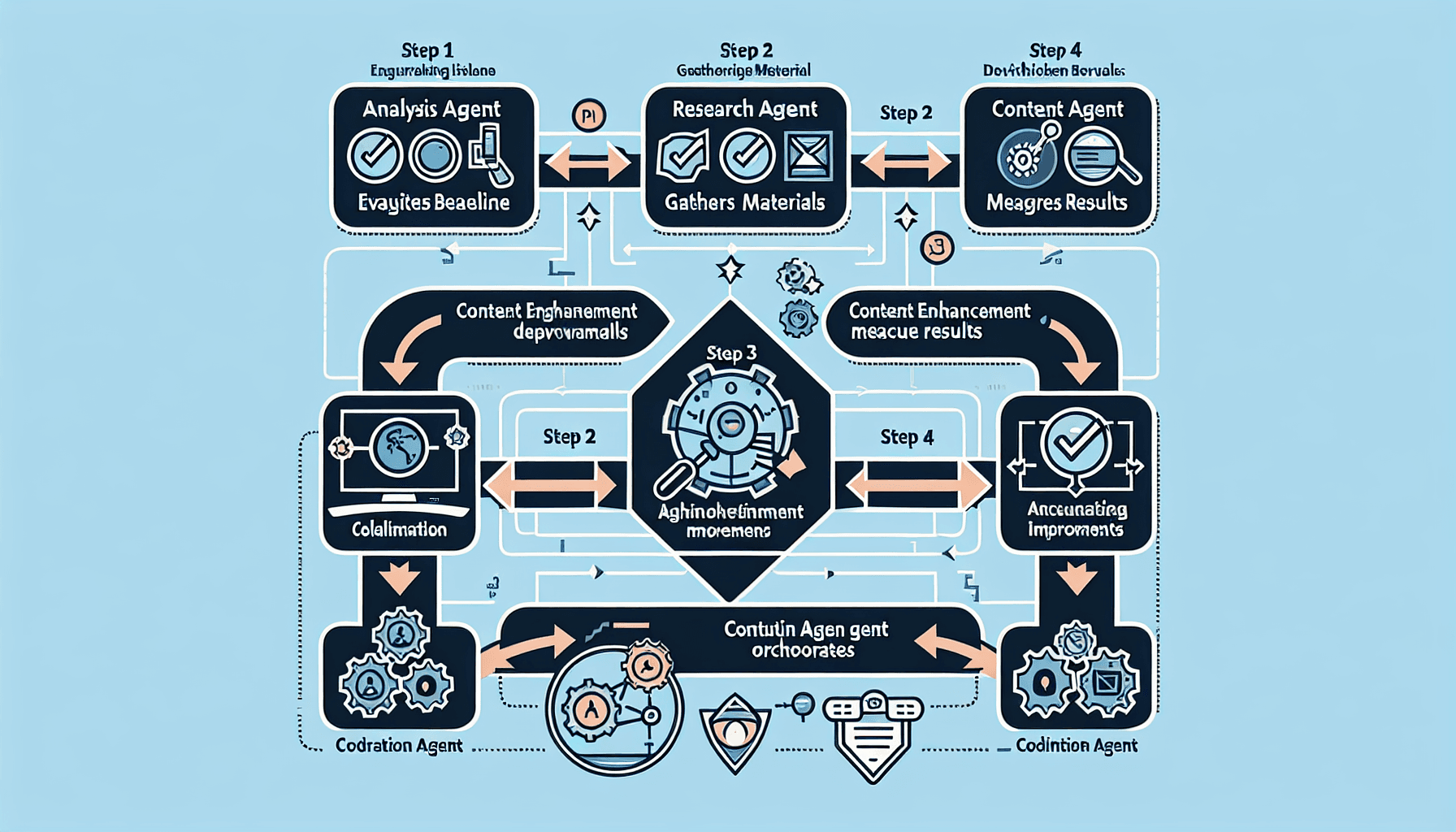
Analysis Agent
- Evaluates current content performance across CC-GSEO-Bench
- Identifies optimization opportunities and weaknesses
- Provides diagnostic insights on content gaps and deficiencies
Research Agent
- Gathers relevant statistics, data, and quantitative information
- Identifies authoritative sources and expert quotes
- Compiles supporting evidence and credibility signals
Content Enhancement Agent
- Integrates research findings into content
- Adds statistics, quotations, and citations systematically
- Optimizes content structure and fluency
Validation Agent
- Evaluates enhanced content against CC-GSEO-Bench
- Measures improvement across visibility and influence metrics
- Identifies areas requiring further refinement
Coordination Agent
- Orchestrates workflow across specialized agents
- Manages iterative optimization cycles
- Ensures coherent integration of agent contributions
Collaborative Workflow
The agents operate in a structured, iterative workflow:
- Initial Assessment: Analysis Agent evaluates baseline content performance
- Research Phase: Research Agent gathers optimization materials (statistics, quotes, sources)
- Enhancement Phase: Content Enhancement Agent integrates research into content
- Validation Phase: Validation Agent measures improvement and identifies remaining gaps
- Iteration: Coordination Agent determines whether additional cycles are needed
- Convergence: Process continues until optimal performance is achieved
This collaborative approach mirrors how human content optimization teams work but operates at machine speed and scale.
Key Research Findings: Effectiveness of Automated Optimization
The CC-GSEO research demonstrates that automated multi-agent optimization significantly outperforms both manual optimization and traditional AI-assisted approaches.
Performance Improvements
Visibility Gains
The multi-agent system achieves:
- 45-60% improvement in content inclusion frequency across diverse queries
- 30-40% improvement in position-adjusted prominence
- 50-70% expansion in query coverage—content appears in responses to broader range of relevant queries
These gains exceed the improvements demonstrated by manual application of GEO strategies (typically 20-40%).
Influence Enhancement
Beyond visibility, the system significantly improves content influence:
- 40-55% increase in response shaping—content more substantially influences AI-generated answers
- 35-45% improvement in attribution quality—content is more prominently and accurately cited
- 45-60% competitive displacement—content displaces competing sources more effectively
Efficiency Advantages
The automated approach provides dramatic efficiency benefits:
- 10-20x speed improvement compared to manual optimization
- Consistent quality across large content portfolios
- Continuous optimization as AI systems evolve
- Scalability to thousands of content pieces without proportional resource increase
Comparative Analysis: Human vs. Automated Optimization
The research includes comparative analysis between:
- Manual Expert Optimization: Human content specialists applying GEO principles
- AI-Assisted Optimization: Human specialists using AI tools for research and drafting
- Multi-Agent Automated Optimization: The CC-GSEO framework
Results demonstrate that while manual expert optimization can achieve high-quality results, it's slow and doesn't scale. AI-assisted optimization improves efficiency but requires significant human oversight. The multi-agent approach achieves comparable or superior quality while operating at machine speed and scale.
Domain-Specific Adaptation: Tailored Optimization Strategies
One of the most significant findings is that the multi-agent system automatically adapts optimization strategies to domain-specific requirements.
Professional Services Optimization
For professional services (legal, consulting, financial advisory), the system emphasizes:
- Credential highlighting: Automatically integrating professional qualifications and certifications
- Case study incorporation: Adding relevant case examples and success metrics
- Expert positioning: Emphasizing domain expertise and thought leadership
E-Commerce and Product Content
For product-related content, the system prioritizes:
- Specification clarity: Structuring technical specifications for AI comprehension
- Comparative context: Adding use case descriptions and product positioning
- Credibility signals: Integrating reviews, ratings, and certifications
Healthcare and Medical Content
For medical and healthcare content, the system focuses on:
- Evidence-based information: Prioritizing peer-reviewed research citations
- Authoritative sourcing: Emphasizing medical institution and expert affiliations
- Clear communication: Optimizing medical information for lay audience comprehension
Local Business Content
For local businesses, the system emphasizes:
- Location-specific information: Geographic and community context
- Local statistics: Relevant local market data and community information
- Authentic local presence: Signals of genuine local operation and community engagement
This automatic domain adaptation eliminates the need for manual strategy customization, enabling efficient optimization across diverse content types.
Technical Innovation: How Multi-Agent Optimization Works
Agent Communication Protocols
The multi-agent system uses sophisticated communication protocols that enable effective collaboration:
Message Passing: Agents communicate findings, requests, and status updates through structured message formats
Shared Knowledge Base: All agents access a centralized knowledge repository containing:
- Baseline content performance data
- Research materials and sources
- Optimization history and versioning
- Performance metrics and benchmarks
Consensus Mechanisms: When agents disagree on optimization approaches, consensus protocols resolve conflicts based on performance data
Iterative Refinement Algorithm
The system implements an iterative refinement algorithm that:
- Measures Baseline: Establishes current content performance across CC-GSEO-Bench
- Identifies Gaps: Determines specific deficiencies (missing statistics, weak citations, unclear structure)
- Applies Optimizations: Each agent contributes domain-specific improvements
- Validates Changes: Measures performance improvement
- Determines Continuation: Decides whether additional iterations are beneficial
- Converges: Reaches optimal performance within computational budget
This algorithm ensures systematic improvement while avoiding over-optimization that could reduce content quality.
Quality Control Mechanisms
The system includes sophisticated quality controls:
Factual Verification: Ensures statistics and claims are accurate and properly sourced
Coherence Maintenance: Preserves content readability and logical flow despite optimization additions
Brand Voice Consistency: Maintains original content's tone and style while adding optimization elements
Citation Quality: Verifies that added sources are authoritative and relevant
These controls ensure that automated optimization maintains high content standards.
Commercial Implications: Scaling GEO Across Content Portfolios
The CC-GSEO framework has profound implications for businesses managing large content portfolios.
Enterprise Content Optimization
Large organizations with thousands of content pieces can:
Achieve Comprehensive Optimization: Optimize entire content libraries systematically rather than selectively
Maintain Current Optimization: Continuously update content as AI systems evolve
Reduce Resource Requirements: Accomplish optimization with smaller teams
Ensure Consistent Quality: Apply evidence-based strategies uniformly across all content
Competitive Dynamics
Automated optimization changes competitive dynamics:
Lowers Entry Barriers: Smaller organizations can achieve optimization quality previously requiring large teams
Accelerates Optimization: First-mover advantages compress as optimization becomes faster
Raises Quality Standards: Baseline content quality expectations increase across industries
Shifts Competitive Focus: Competition shifts from optimization execution to content substance and authenticity
Investment Considerations
The CC-GSEO framework suggests that investment in GEO should prioritize:
- Content Foundation: High-quality base content that automation can enhance
- Multi-Agent Infrastructure: Systems for deploying and managing agent-based optimization
- Measurement Capabilities: Tracking content performance across generative engines
- Continuous Monitoring: Ongoing evaluation and re-optimization as AI systems evolve
- Domain Expertise: Human oversight ensuring content accuracy and relevance
Limitations and Ethical Considerations
The research acknowledges important limitations and ethical considerations:
Technical Limitations
Dependence on AI Quality: System effectiveness depends on underlying AI capabilities
Evaluation Lag: Performance measurement requires time to assess impact across generative engines
Domain Boundaries: Some specialized domains may require human expertise beyond agent capabilities
Over-Optimization Risk: Excessive optimization could reduce content quality or authenticity
Ethical Considerations
Authenticity Concerns: Automated optimization could prioritize visibility over content value
Information Influence: Widespread adoption could disproportionately influence AI-generated information
Source Diversity: Optimization could reduce diversity of sources in AI responses
Quality vs. Visibility Trade-offs: Systems might sacrifice content quality for visibility metrics
The research emphasizes that automated optimization should enhance rather than replace human expertise, and that content quality and accuracy must remain paramount.
Future Research Directions
The CC-GSEO framework opens several avenues for future research:
Personalization and Context
How can multi-agent systems adapt optimization to personalized and contextual search scenarios?
User Context: Optimizing for specific user demographics, preferences, and needs
Temporal Context: Adapting optimization for seasonal, trending, or time-sensitive information
Geographic Context: Tailoring content for location-specific relevance
Multi-Modal Content Optimization
As generative engines incorporate images, video, and interactive content, how should optimization evolve?
Visual Content: Optimizing images and graphics for AI comprehension and recommendation
Video Integration: Enhancing video content visibility in generative search
Interactive Elements: Optimizing interactive content for AI-driven discovery
Cross-Platform Consistency
How can optimization remain effective across diverse generative engines with different architectures and training?
Platform-Specific Adaptation: Tailoring optimization for specific AI systems
Unified Strategies: Identifying optimization approaches that work across all platforms
Performance Prediction: Forecasting optimization effectiveness across different engines
Conclusion: The Future of Content Optimization
The CC-GSEO framework represents a fundamental shift in how content optimization can be approached. By automating the application of evidence-based GEO strategies through multi-agent systems, the research demonstrates that:
- Automation is Viable: Multi-agent systems can effectively optimize content for generative engines
- Scale is Achievable: Large content portfolios can be optimized systematically
- Quality is Maintainable: Automated optimization can maintain or improve content quality
- Adaptation is Automatic: Systems can adjust strategies for domain-specific requirements
- Performance is Superior: Automated approaches outperform manual optimization in speed and often quality
For businesses navigating the transition from SEO to GEO, the implications are clear: while human expertise remains essential for content creation and strategy, automated multi-agent systems can dramatically improve the efficiency and effectiveness of optimization implementation.
The research also suggests that GEO optimization will increasingly become automated infrastructure rather than manual practice. Just as modern websites use automated SEO tools for technical optimization, future content strategies will incorporate automated GEO systems for generative search optimization.
The shift beyond keywords to content-centric, AI-driven optimization represents not just a tactical change but a strategic transformation in digital content strategy. Organizations that adopt automated optimization frameworks will gain significant advantages in visibility, efficiency, and scalability as generative search becomes the dominant mode of information discovery.
References
-
Chen, Q., Chen, J., Huang, H., Shao, Q., Chen, J., Hua, R., Xu, H., Wu, R., Chuan, R., & Wu, J. (2024). Beyond Keywords: Driving Generative Search Engine Optimization with Content-Centric Agents. arXiv preprint arXiv:2509.05607. https://arxiv.org/abs/2509.05607
-
Aggarwal, P., Murahari, V., Rajpurohit, T., Kalyan, A., Narasimhan, K., & Deshpande, A. (2024). GEO: Generative Engine Optimization. Proceedings of the 30th ACM SIGKDD Conference on Knowledge Discovery and Data Mining (KDD '24). arXiv:2311.09735
-
Bagga, P. S., Farias, V. F., Korkotashvili, T., Peng, T., & Wu, Y. (2025). E-GEO: A Testbed for Generative Engine Optimization in E-Commerce. arXiv preprint arXiv:2511.20867. https://arxiv.org/abs/2511.20867
For organizations managing large content portfolios, the CC-GSEO framework demonstrates that automated multi-agent optimization can achieve superior GEO performance while dramatically improving efficiency and scalability—representing the future of content optimization in the age of generative search.
Explore Related Topics
Learn More About GEO
Related GEO Articles
Explore our comprehensive coverage of Generative Engine Optimization:
Related Articles
Do Wikidata Entities Help Real Estate Agencies Show Up in ChatGPT? A 2026 Real Estate AI Visibility Experiment
We tested US real estate agencies with and without Wikidata entities across matched local markets. The average result was only slightly positive, while the lone rich-entity follow-up was encouraging but too small to generalize.
The Research Behind Wikidata and AI Visibility (No Vendors, Just Proof)
Non-vendor evidence that Wikidata feeds AI visibility—and why knowledge graph publishing and Wikidata publishing belong in your agency stack. Research-backed case for agencies.
Reasoning on Graphs: How Knowledge Graphs Make AI Assistants More Accurate
New research reveals how knowledge graphs enable faithful, interpretable reasoning in AI assistants—and why this matters for business visibility in ChatGPT, Claude, and Perplexity
Generative Engine Optimization for Law Firms (2026): GEO Software + AI Visibility Guide
A practical generative engine optimization guide for law firms: GEO software options, GEO analysis methods, and how to improve AI visibility for legal queries.
Wikidata for Local SEO Agencies: April 2026 Data Snapshot
Live Wikidata data shows how few US local businesses are represented in the knowledge graph, and why this is an attainable GEO opportunity for SEO agencies.
From Homepage to Knowledge Graph: How We Enriched Real Showcase Businesses on Wikidata
Inside GEMflush’s live Wikidata enrichment for homepage showcase clients: research, references, API publishing, and why structured entity data matters for AI visibility and GEO.