Do Wikidata Entities Help Law Firms Show Up in ChatGPT? A 2026 Legal AI Visibility Experiment
Do Wikidata Entities Help Law Firms Show Up in ChatGPT? A 2026 Legal AI Visibility Experiment
If you publish a law firm to Wikidata, will it show up more often in ChatGPT and other AI assistants?
That is the commercial question behind this experiment. It matters because legal discovery is one of the most plausible places for knowledge-graph structure to help: law firms compete in local markets, prompts often include practice area plus city, and many firms have ambiguous names or weak standalone identity outside directories.
We designed this study to test that idea using existing Wikidata entities only. No waiting for a newly published entity to propagate. No before-and-after lag. Just a comparison between firms that already had Wikidata entities and locally matched firms that did not have an exact Wikidata website match.
The result was more nuanced than a simple yes or no.
If your team is thinking about law firm visibility in ChatGPT, this is the data-backed version of that question: not how to publish in theory, but whether existing Wikidata entities appear to improve legal AI visibility in practice.
Quick Takeaway
Here is the clearest reading of the data:
- Some individual law firms with rich Wikidata entities did outperform local controls.
- That means Wikidata publishing may have potential value for some firms as an identity amplifier.
- But when we expanded the rich-only legal sample, the overall effect went flat.
- So the evidence does not support the claim that publishing to Wikidata reliably increases law-firm visibility on average.
That distinction is the whole story. There may be value here, but it is conditional value, not universal lift.
Why Law Firms Seemed Like a Strong Test Case for AI Visibility
We had good reasons to expect law firms might perform better than clinics in a matched local study:
- legal prompts naturally combine practice area + geography
- law firms often need organization-level disambiguation
- many legal markets include both large firms and smaller boutiques with very different identity clarity
- clients often ask for firms, not just generic service providers
If you are new to the broader framework behind this, it helps to read why Wikidata matters for AI visibility and then come back to the legal-specific result here.
What We Tested in This Law Firm ChatGPT Visibility Study
We built a matched legal cohort with:
- US law firms that already had Wikidata entities
- two locally matched comparison firms for each treatment firm
- comparator firms screened for no exact Wikidata
P856website match
That exact P856 filter is not perfect. It does not prove that no alternate alias exists in Wikidata. But it is far stronger than a loose name-only check and gave us a practical control arm for the experiment.
The prompts focused on local legal discovery, not brand-name lookups. They asked questions like:
- which law firms in a city are best regarded for a given practice area
- which firm names someone should search first
- which firms are easiest to distinguish as organizations rather than attorney profiles
- which firms are associated with a specific matter type
Those prompts matter because they are exactly where structured identity might help.
The Prompt Strategy for Legal AI Discovery
The legal battery combined neutral local-discovery prompts with disambiguation-oriented prompts.
The neutral prompts asked which firms in a local market were best regarded or worth researching first.
The disambiguation prompts went further and asked for:
- actual firm names rather than individual attorneys
- firms with the clearest standalone identity
- firms most specifically associated with a matter type
- firms a search system would identify correctly by name, location, and official website
That combination was deliberate. If Wikidata is useful here, it should show up most clearly when the model has to recognize a firm as a distinct organization in a specific market.
Result 1: Broad Legal Visibility Pilot
The first legal run used:
- 10 Wikidata-present law firms
- 20 matched local comparators
- 30 firms total
- OpenAI only
- combined prompt battery
- pilot mode
The broad result was weak:
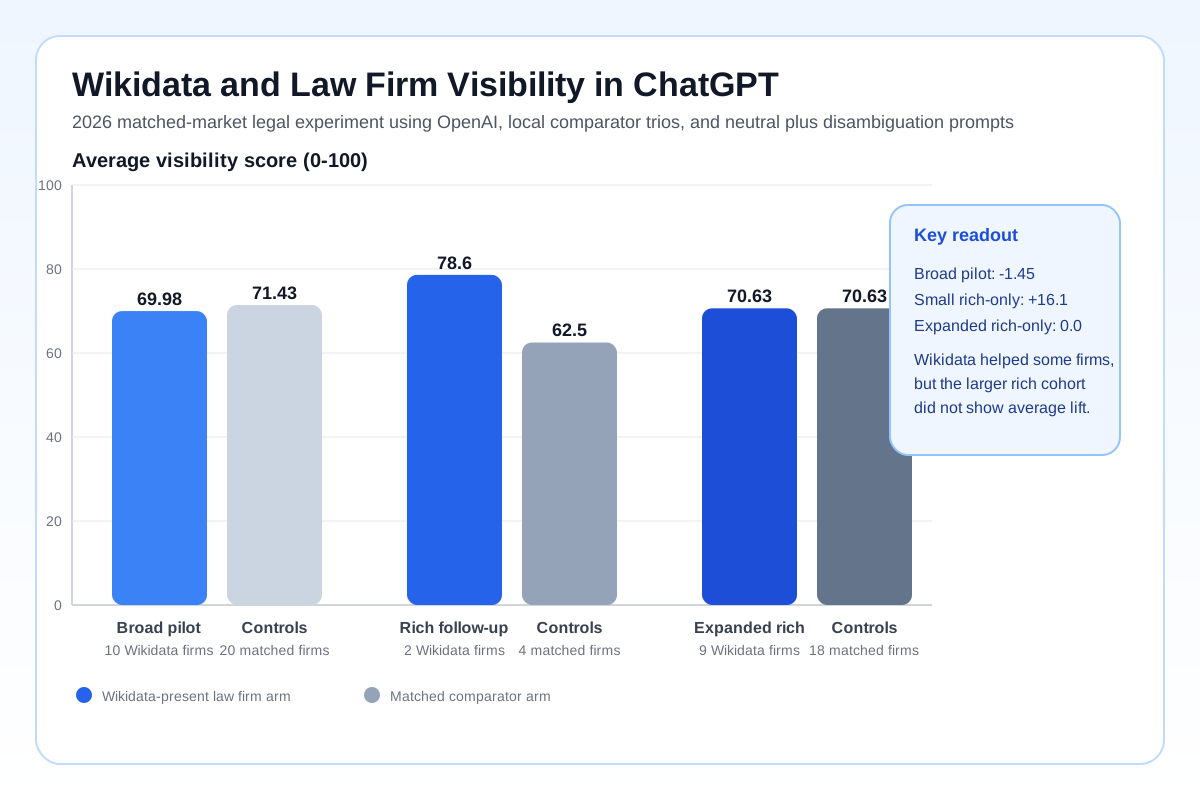
- mean visibility for Wikidata-present firms: 69.98
- mean visibility for matched comparators: 71.43
- mean difference: -1.45 points
- Welch two-sided p-value: 0.767
- Cohen's d: -0.103
At the matched-trio level:
- 6 trios favored the Wikidata firm
- 4 favored the comparator mean
- 0 tied
That is mixed, but not persuasive. The average effect was slightly negative, the p-value was nowhere near conventional significance, and the standardized effect was tiny.
Result 2: Small Rich-Only Follow-Up
The first rich-only follow-up looked much more promising, but it was tiny.
Only 2 firms in the original legal cohort qualified for the rich subgroup:
Guardian Law GroupLatham & Watkins
That 2-firm rich-only follow-up produced:
- mean visibility for rich-entity firms: 78.6
- mean visibility for matched comparators: 62.5
- mean difference: +16.1 points
- both matched trios favored the Wikidata firm
That was encouraging, but it was not enough. With only two treatment firms, the result could not bear much interpretive weight.
So we did the more important thing: we expanded the rich-only cohort.
Result 3: Expanded Rich-Only Legal Cohort
We then built a larger rich-only legal sample with:
- 9 rich Wikidata law firms
- 18 local comparators
- 27 firms total
This is the result that matters most, because it is large enough to challenge the tempting story from the 2-firm follow-up.
The expanded rich-only result finished completely flat:
- mean visibility for rich Wikidata firms: 70.63
- mean visibility for matched comparators: 70.63
- mean difference: 0.00
- Welch two-sided p-value: ~1.00
- Cohen's d: 0
At the matched-trio level:
- 4 favored the Wikidata firm
- 4 favored the comparator mean
- 1 tied
That is the strongest evidence in the study, and it says the average rich-only effect for law firms was not positive in this pilot.
Why the Expanded Rich-Only Run Still Matters
Even though the rich-only average ended up flat, the trio breakdown is still interesting.
Some firms did very well. Others did badly. That suggests Wikidata can matter, but only under certain conditions.
Strong positive cases
The biggest positive case was Kenneth S. Nugent, P.C. in Atlanta:
- visibility score: 85.7
- comparator mean: 60.7
- matched delta: +25.0
Other positive rich cases included:
- Dickinson Wright in Detroit: +10.7
- Crowell & Moring in Washington, DC: +3.6
- Latham & Watkins in Los Angeles: +3.5
Strong negative cases
The biggest negative cases included:
- McDermott Will & Emery in Chicago: -14.3
- Opelon LLP in Carlsbad: -14.3
- Cahill, Gordon, & Reindel in New York City: -10.7
So the data does not say "Wikidata never helps law firms." It says the benefit was inconsistent and competed with other stronger forces.
Why Some Firms Seemed to Benefit
The best explanation from this dataset is that Wikidata helped only when it reinforced an already favorable retrieval situation.
That seems to happen when three things line up:
- The firm has a clear standalone organization identity
- The prompt has a strong practice-area plus geography fit
- The local comparator firms are not overwhelmingly more salient to the model already
In that setup, a rich Wikidata entity may make it easier for the model to:
- recognize the firm as a firm rather than a lawyer profile
- connect the firm to the right market and practice context
- surface the organization name more consistently
That is why I think of Wikidata here as a possible identity amplifier, not a guaranteed ranking boost.
Why Other Firms Did Not Benefit
The losing cases suggest that rich entity quality is often weaker than broader brand salience.
For example, some comparator firms appear to have been highly legible to the model already because of:
- market prominence
- strong directory presence
- major web footprint
- well-known brand names in legal search
When that happens, a rich Wikidata entity is not enough by itself to overcome the model's prior familiarity with the competing firms.
In other words, if a non-Wikidata comparator is already very easy for the model to recall from general web/legal signals, Wikidata richness may not move the outcome much at all.
Secondary Outcomes
The refined runs also tracked:
- Top-1 rate
- Top-3 rate
- Correct website rate
The most important secondary result from the expanded rich-only run is that these also failed to show a broad advantage:
- mean top-1 rate for rich Wikidata firms: 8.73
- mean top-1 rate for comparators: 14.68
- mean top-3 rate for rich Wikidata firms: 36.52
- mean top-3 rate for comparators: 41.67
- correct website rate: 0 for both arms
That matters because it reduces the space for optimistic reinterpretation. The average rich-only result was not hiding a stronger top-1 or website-surfacing effect.
What This Means for Law Firms
This study does not justify saying:
- "Publishing to Wikidata will make your law firm show up in ChatGPT."
- "Rich law-firm entities have a proven average lift."
- "Wikidata alone is enough to win local legal discovery."
But it does justify a narrower and more credible claim:
- publishing to Wikidata may have potential value for some firms
- that value appears to be conditional rather than universal
- the most likely mechanism is improved identity recognition, not guaranteed rank dominance
That is still useful from a strategy standpoint. If you can control only one structured-data lever, Wikidata may still be worth doing, especially for firms that:
- have a distinctive local brand
- need better organization-level recognition
- serve a specific practice area in a clear geography
- are not already dominant from broader legal-web signals
The Practical Business Framing
If you are running a GEO or AI visibility program for law firms, the takeaway should be:
- Do not promise average lift from Wikidata alone
- Do position Wikidata as one controllable identity layer
- Expect the biggest upside in firms where identity clarity is the bottleneck
That is a more credible value proposition than the simplistic claim that "being in Wikidata makes AI recommend you."
The evidence here says that is too broad.
Comparison With the Clinic Experiment
This legal result is also useful because it contrasts with our medical-clinic experiment.
In clinics, the broad effect was weak, but the rich-entity subgroup looked materially stronger in the initial study. In law firms, the broad effect was weak, the tiny rich-only follow-up looked promising, and the expanded rich-only cohort flattened out again.
That difference suggests the mechanism may be more domain-specific than it first appears. For a related local-business experiment, see our clinic Wikidata visibility study.
FAQ
Does Wikidata help law firms show up in ChatGPT?
Sometimes, but not reliably on average in this experiment. Some rich Wikidata law-firm entities beat their local controls, but the expanded rich-only cohort finished flat overall.
Is publishing a law firm to Wikidata still worth it?
Potentially yes, especially if the firm has a clear local identity and practice-area fit. The best interpretation of this dataset is that Wikidata can act as an identity amplifier for some firms, not a guaranteed lift for all firms.
What kind of law firms looked most likely to benefit?
The positive cases tended to be firms with clearer organization-level identity in a specific local market. The losing cases were often up against comparator firms that already had strong web and brand salience.
What is the main strategic lesson for legal SEO and GEO?
Use Wikidata as one structured-data layer, not as a standalone promise. The safer positioning is: improve entity clarity, local relevance, and AI visibility measurement together rather than expecting Wikidata alone to change outcomes.
Final Takeaway
Here is the most honest conclusion from the data:
Yes, some law firms appear to benefit from having rich Wikidata entities.
But:
- the effect is not stable across the cohort
- the average rich-only effect disappeared when we expanded the sample
- the most likely value is conditional, not universal
So if you are thinking about Wikidata publishing for law firms, the right belief is not:
"This will probably boost everyone."
It is:
"This may help some firms surface more often when entity recognition is the limiting factor, but we should not assume an average lift without testing the specific firm and market."
That is a less exciting headline than a blanket win. It is also much closer to what the data actually says.
Related Reading
Explore Related Topics
Industry Resources
Learn More About GEO
Related GEO Articles
Explore our comprehensive coverage of Generative Engine Optimization:
Related Articles
What SPARQL Reveals About a Law Firm That Brochure Copy Never Would: Rose Law Firm on Wikidata
Run SPARQL on Wikidata and you get more than addresses and practice areas. Here is one Arkansas firm where the graph encodes a tautological industry tag, a two-century inception, and a social follower count in the same row—and why that matters for AI discovery.
Do Wikidata Entities Help Real Estate Agencies Show Up in ChatGPT? A 2026 Real Estate AI Visibility Experiment
We tested US real estate agencies with and without Wikidata entities across matched local markets. The average result was only slightly positive, while the lone rich-entity follow-up was encouraging but too small to generalize.
Do Wikidata Entities Help Clinics Show Up in ChatGPT? Our 2026 Experiment Found the Strongest Gains in Rich Existing Entities
We tested 30 clinics to see whether existing Wikidata entities improve LLM visibility. The broad average lift was small, but rich clinic entities showed a much stronger local discovery signal.
The Research Behind Wikidata and AI Visibility (No Vendors, Just Proof)
Non-vendor evidence that Wikidata feeds AI visibility—and why knowledge graph publishing and Wikidata publishing belong in your agency stack. Research-backed case for agencies.
Law Firm Visibility in ChatGPT: How to Get Your Practice Discovered by AI Assistants
Learn how law firms can achieve AI visibility in ChatGPT and other AI assistants. Step-by-step guide to getting your legal practice discovered by AI-powered search.
Generative Engine Optimization for Law Firms (2026): GEO Software + AI Visibility Guide
A practical generative engine optimization guide for law firms: GEO software options, GEO analysis methods, and how to improve AI visibility for legal queries.