Do Wikidata Entities Help Real Estate Agencies Show Up in ChatGPT? A 2026 Real Estate AI Visibility Experiment
Do Wikidata Entities Help Real Estate Agencies Show Up in ChatGPT? A 2026 Real Estate AI Visibility Experiment
If you publish a real estate agency to Wikidata, will it show up more often in ChatGPT and other AI assistants?
That is the commercial question behind this experiment. Real estate is a plausible place for entity structure to matter because discovery prompts often combine market segment + geography + transaction intent. Buyers and sellers ask about agencies in a city, a county, or a niche like luxury homes, relocation, or commercial leasing. If Wikidata helps anywhere, it should be in that kind of entity-heavy local discovery.
We tested that idea using existing Wikidata entities only. No before-and-after publishing lag. No speculative "maybe it will propagate later" story. Just a matched comparison between agencies that already had Wikidata entities and local comparators that did not have an exact Wikidata P856 website match.
The result was directionally interesting, but not strong enough to support a broad claim.
If your team is thinking about generative engine optimization for real estate agencies, this is the experimental version of that question: not whether structured data sounds useful in theory, but whether existing Wikidata entities appear to improve real-estate AI visibility in practice.
Quick Takeaway
Here is the shortest honest read of the data:
- The broad real-estate pilot finished slightly positive, but the effect was weak and statistically unconvincing.
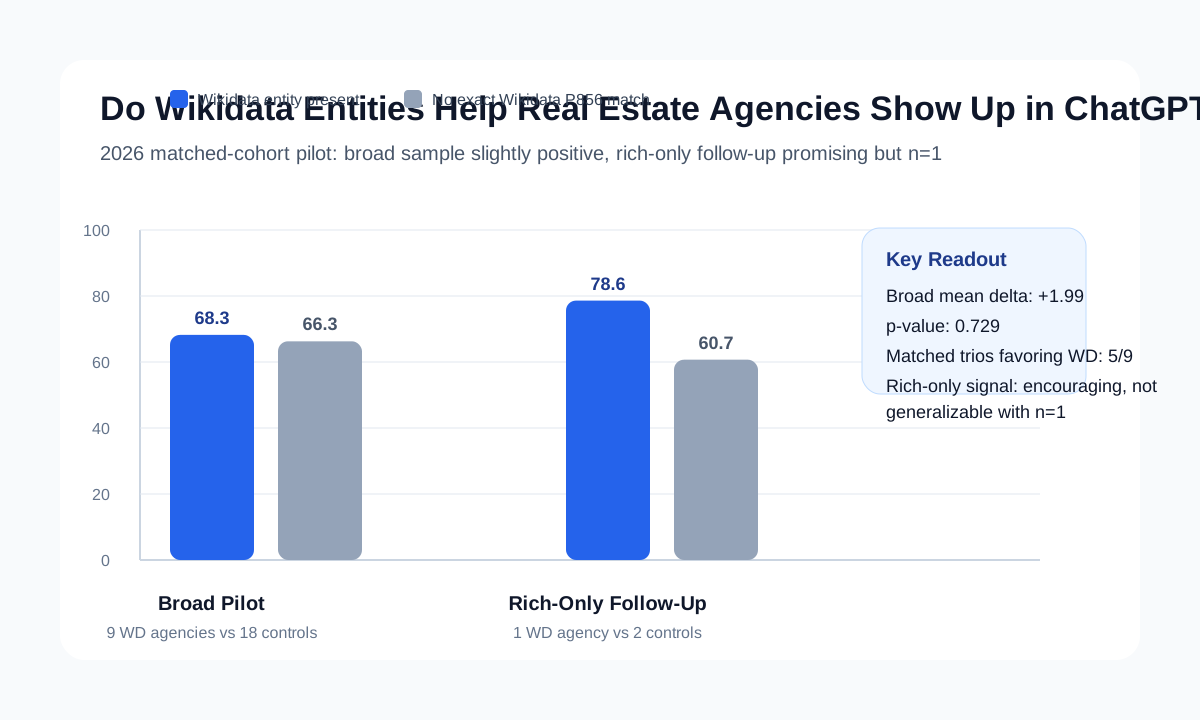
- 5 of 9 matched trios favored the Wikidata agency, 3 favored the local controls, and 1 tied.
- The lone
richreal-estate follow-up showed a strong positive delta, but it had only one treatment agency, so it is anecdotal. - The safest interpretation is possible conditional upside, weak average evidence, and severe data scarcity.
That last point matters most. Real estate did not give us enough rich US entities to make a confident rich-only cohort the way we attempted in law firms.
Why Real Estate Was Worth Testing
Real estate was a useful domain for three reasons:
- prompts naturally combine location + property intent + agency identity
- agency discovery often depends on organization-level recognition
- the market includes both national brands and highly local agencies with very different baseline salience
That mix creates a good stress test for the idea that public entity structure might help the model retrieve the right agency more consistently.
For the broader background on why this matters, it helps to read why Wikidata matters for AI visibility first and then return to this real-estate-specific result.
What We Tested in This Real Estate ChatGPT Visibility Study
We built a matched cohort with:
- 9 US real estate agencies that already had Wikidata entities
- 18 locally matched comparison agencies
- comparator agencies screened for no exact Wikidata
P856website match
That exact P856 screen is stronger than a loose name-only check, but weaker than proving that no alternate alias exists anywhere in Wikidata. So this is a practical observational control arm, not a perfect proof of Wikidata absence.
The prompts focused on local agency discovery, not direct brand-name lookups. They asked which agencies in a region someone should research for:
- residential buying or selling
- commercial leasing or acquisition
- island-property transactions
- other local market-specific intents
Those prompts were chosen because they are the kind most likely to reward clean entity recognition if Wikidata is helping.
The Prompt Strategy for Real Estate AI Discovery
The real-estate battery combined neutral local-discovery prompts with disambiguation-oriented prompts.
The neutral prompts asked which agencies in a market were best regarded or worth researching first.
The disambiguation prompts asked for:
- actual agency names rather than generic brokerage categories
- agencies with the clearest organization identity in a local market
- agencies associated with a transaction type or market segment
- agencies a model could distinguish by name, place, and official website
That design matters because Wikidata, if it helps, should show up most clearly when the model needs to identify a specific organization rather than just generate generic advice about buying or selling real estate.
Result 1: Broad Real Estate Visibility Pilot
The first real-estate run used:
- 9 Wikidata-present agencies
- 18 matched local comparators
- 27 agencies total
- OpenAI only
- combined prompt battery
- pilot mode
The broad result was slightly positive, but weak:
- mean visibility for Wikidata-present agencies: 68.26
- mean visibility for matched comparators: 66.26
- mean difference: +1.99 points
- Welch two-sided p-value: 0.729
- Cohen's d: 0.149
At the matched-trio level:
- 5 favored the Wikidata agency
- 3 favored the comparator mean
- 1 tied
That is directionally better than the broad law-firm pilot, but it still does not justify saying that Wikidata entities reliably improve real-estate visibility on average.
What the Broad Trio Breakdown Suggests
The trio-level pattern was not random-looking. A few agencies clearly beat their matched controls:
- Trustworthy Agents Group in Chesapeake: +21.4 visibility points
- Redfin in Seattle: +17.9
- Howard Hanna Real Estate Services in Pittsburgh: +10.7
- L1ST Group in Charlotte: +10.6
There were also clear losing cases:
- Standard Brokerage Company in Albany: -28.5 visibility points
- Norman Homes in Mound: -10.8
- Weichert, Realtors in Morris Plains: -10.7
That kind of spread is exactly why the average result stayed modest. Some Wikidata-present agencies did substantially better than local controls, but others were comfortably beaten by the comparison set.
Result 2: The Rich-Only Follow-Up
The real-estate follow-up on rich entities was directionally encouraging but extremely limited.
Only 1 agency in the cohort qualified for the rich subgroup:
Standard Brokerage Company
That one-agency rich-only follow-up produced:
- mean visibility for the rich Wikidata agency: 78.6
- mean visibility for matched comparators: 60.7
- mean difference: +17.9 points
- top-1 rate difference: +10.7
- top-3 rate difference: +10.7
That is a strong directional result. But with n = 1, it is not evidence of an average rich-entity effect. It is better understood as a promising anecdote that justifies more data collection.
Why the Real Estate Result Is Still Hard to Generalize
The biggest limitation in this domain was not the model. It was the data layer.
Compared with clinics or law firms, US real estate agencies had much thinner usable Wikidata coverage for this exact study design. We could build a viable broad cohort, but we could not build a convincing rich-only sample large enough to support a stable claim.
That leaves three credible possibilities:
- Wikidata has little average effect in real estate.
- Wikidata helps only certain agencies under certain market conditions.
- Wikidata does help rich entities more, but current US real-estate coverage is too sparse to measure that cleanly yet.
The current data cannot distinguish those three with high confidence.
Why Some Agencies May Have Benefited
The positive cases suggest that Wikidata may help when it reinforces an already favorable retrieval situation.
That seems most plausible when:
- the agency has a clear standalone organization identity
- the prompt has strong local and transactional specificity
- the local control agencies are not overwhelmingly more salient already
In that setup, Wikidata may act as an identity amplifier. It can make it easier for the model to connect the agency to the right place, the right type of transaction, and the right organization name.
That framing fits the strongest positive cases in the broad cohort, especially the agencies that appear more legible as organizations than as loose collections of agent profiles.
Why Other Agencies Did Not Benefit
The losing cases suggest that Wikidata richness is often weaker than broader market salience.
In real estate, a comparator agency can be highly legible to the model already because of:
- large web footprint
- strong listing-platform presence
- local directory coverage
- brand familiarity from the broader real-estate web
When those signals are already strong, a Wikidata entity may not add much, and sometimes the control agencies still win decisively.
That is why this dataset does not support the simplistic claim that "publishing to Wikidata makes real estate agencies rank in AI."
Secondary Outcomes
The broad pilot also tracked:
- Top-1 rate
- Top-3 rate
- Correct website rate
These secondary metrics also failed to show a broad breakout:
- mean top-1 rate for Wikidata agencies: 10.3
- mean top-1 rate for comparators: 11.49
- mean top-3 rate for Wikidata agencies: 38.89
- mean top-3 rate for comparators: 38.51
- correct website rate: 0 for both arms
That is an important reality check. The slight visibility advantage in the broad cohort was not hiding a strong top-rank or website-surfacing effect.
What This Means for Real Estate Agencies
This study does not justify saying:
- "Publishing our brokerage to Wikidata will make ChatGPT recommend us."
- "Wikidata entities have proven average lift for real estate."
- "Rich entities are already enough to win local agency discovery."
But it does justify a narrower and more credible claim:
- Wikidata may have potential value for some agencies
- that value appears more likely to be conditional than universal
- the most plausible mechanism is improved entity recognition, not guaranteed ranking dominance
That is still strategically useful. Wikidata is one of the few public, controllable entity layers a business can influence directly.
The Practical Business Framing
If you are running GEO or AI visibility work for a real-estate agency, the practical takeaway should be:
- Do not promise average lift from Wikidata alone
- Do treat Wikidata as a controllable identity layer
- Expect the most upside where organization clarity is the bottleneck
- Pair entity work with broader web authority, brand mentions, and market-specific content
That is a stronger strategic position than promising that knowledge-graph publication by itself will change outcomes.
Comparison With the Law-Firm and Clinic Studies
This result is useful partly because it sits between the other two local-business studies we ran.
Compared with our law-firm Wikidata visibility experiment, real estate was directionally more positive on the broad average but far worse on rich-sample availability. Compared with our clinic Wikidata visibility study, the real-estate domain looks even more constrained by sparse entity coverage.
That means the best present conclusion for real estate is not "Wikidata works" or "Wikidata fails." It is:
the upside may be real for some agencies, but the current US entity base is too thin to prove broad or rich-only lift cleanly.
FAQ
Does Wikidata help real estate agencies show up in ChatGPT?
Sometimes maybe, but not reliably enough to make a broad claim from this dataset. The broad matched study was only slightly positive, and the rich-only follow-up had just one agency.
Is publishing a real estate agency to Wikidata still worth it?
Potentially yes, especially if the agency needs stronger organization-level recognition and competes in prompts with clear geographic and transaction intent. But the current evidence supports conditional value, not guaranteed lift.
Why was the rich-only result not more conclusive?
Because only one agency in the cohort qualified for the rich subgroup. A positive result with n = 1 is directionally interesting, but it is not enough to estimate an average treatment effect for the category.
What is the main strategic lesson for real-estate GEO?
Use Wikidata as one entity and identity layer inside a broader AI visibility program. The safer positioning is: improve structured identity, local market signals, and measurement together instead of assuming Wikidata alone will change rankings.
Final Takeaway
Here is the most honest conclusion from the real-estate data:
Existing Wikidata entities may help some real estate agencies surface more often in AI-assisted local discovery.
But:
- the broad average effect was small
- the statistical evidence was weak
- the one positive rich-only follow-up was too small to generalize
- the domain suffers from severe real-estate entity scarcity in Wikidata
So if you are thinking about Wikidata publishing for a brokerage, the right belief is not:
"This will probably boost us."
It is:
"This may help if entity recognition is a bottleneck, but we should treat it as one controllable identity input and test outcomes instead of assuming average lift."
That is a less promotional conclusion than a blanket win. It is also much closer to what the data actually says.
Related Reading
Explore Related Topics
Industry Resources
Learn More About GEO
Related GEO Articles
Explore our comprehensive coverage of Generative Engine Optimization:
Related Articles
The Research Behind Wikidata and AI Visibility (No Vendors, Just Proof)
Non-vendor evidence that Wikidata feeds AI visibility—and why knowledge graph publishing and Wikidata publishing belong in your agency stack. Research-backed case for agencies.
Do Wikidata Entities Help Law Firms Show Up in ChatGPT? A 2026 Legal AI Visibility Experiment
We tested US law firms with and without Wikidata entities across matched local markets to measure ChatGPT visibility. Some firms benefited, but the expanded rich-only cohort finished flat overall.
Do Wikidata Entities Help Clinics Show Up in ChatGPT? Our 2026 Experiment Found the Strongest Gains in Rich Existing Entities
We tested 30 clinics to see whether existing Wikidata entities improve LLM visibility. The broad average lift was small, but rich clinic entities showed a much stronger local discovery signal.
US Real Estate Companies in Wikidata by State (2026)
How many US real estate companies and realtors appear in Wikidata by state? Data-driven look at real estate knowledge graph coverage and AI visibility.
Wikidata for Local SEO Agencies: April 2026 Data Snapshot
Live Wikidata data shows how few US local businesses are represented in the knowledge graph, and why this is an attainable GEO opportunity for SEO agencies.
From Homepage to Knowledge Graph: How We Enriched Real Showcase Businesses on Wikidata
Inside GEMflush’s live Wikidata enrichment for homepage showcase clients: research, references, API publishing, and why structured entity data matters for AI visibility and GEO.