How to Engineer Knowledge Graphs for Better LLM Semantics: A Technical Deep Dive
Engineering Knowledge Graphs for LLM Semantics: A Technical Deep Dive
Large Language Models (LLMs) have revolutionized how AI systems understand and generate human language. However, their semantic understanding is fundamentally shaped by the structured knowledge graphs from which they derive meaning. This technical analysis explores how knowledge graph engineering directly influences LLM semantics, reasoning capabilities, and output quality—presenting both opportunities and challenges for AI system designers and content creators.
If you are shipping public knowledge graph work for client visibility, see GEMflush plans, AI visibility for SEO agencies, and the agency GEO offer. For how GEO tools compare, read the GEO platform comparison.
A Meta-Observation: The Images in This Post
Before diving into the technical details, it's worth noting that the illustrations in this post were generated using DALL-E 3, an AI image generation model. If you've noticed that these images are clearly AI-generated—perhaps with inconsistent details, surreal elements, or that characteristic "AI art" aesthetic—you're experiencing a perfect demonstration of why structured knowledge graphs matter.
The Problem with Unstructured Generation: DALL-E, like text-generating LLMs, operates primarily through pattern matching and statistical generation. Without structured constraints, it produces creative but often inconsistent results. The images may have logical inconsistencies, impossible geometries, or elements that don't quite make sense—because the model lacks explicit structural knowledge about how concepts should relate.
The Knowledge Graph Solution: This is precisely why knowledge graphs are essential. They provide explicit, verifiable structure that constrains and guides AI understanding. While DALL-E generates images through statistical patterns (resulting in the "AI art" aesthetic you may notice), knowledge graphs encode relationships explicitly: "Entity X is connected to Entity Y through Property Z" is a verifiable fact, not a statistical approximation.
This contrast—between the creative but inconsistent output of unstructured generation and the reliable, structured information in knowledge graphs—illustrates the core thesis of this post: structured knowledge graphs provide the semantic scaffolding that makes LLM outputs accurate, verifiable, and useful.
As you read through the technical analysis below, consider how the knowledge graph structures we discuss could help improve not just text generation, but all forms of AI output by providing explicit semantic constraints.
The Semantic Foundation: Knowledge Graphs as LLM Training Data
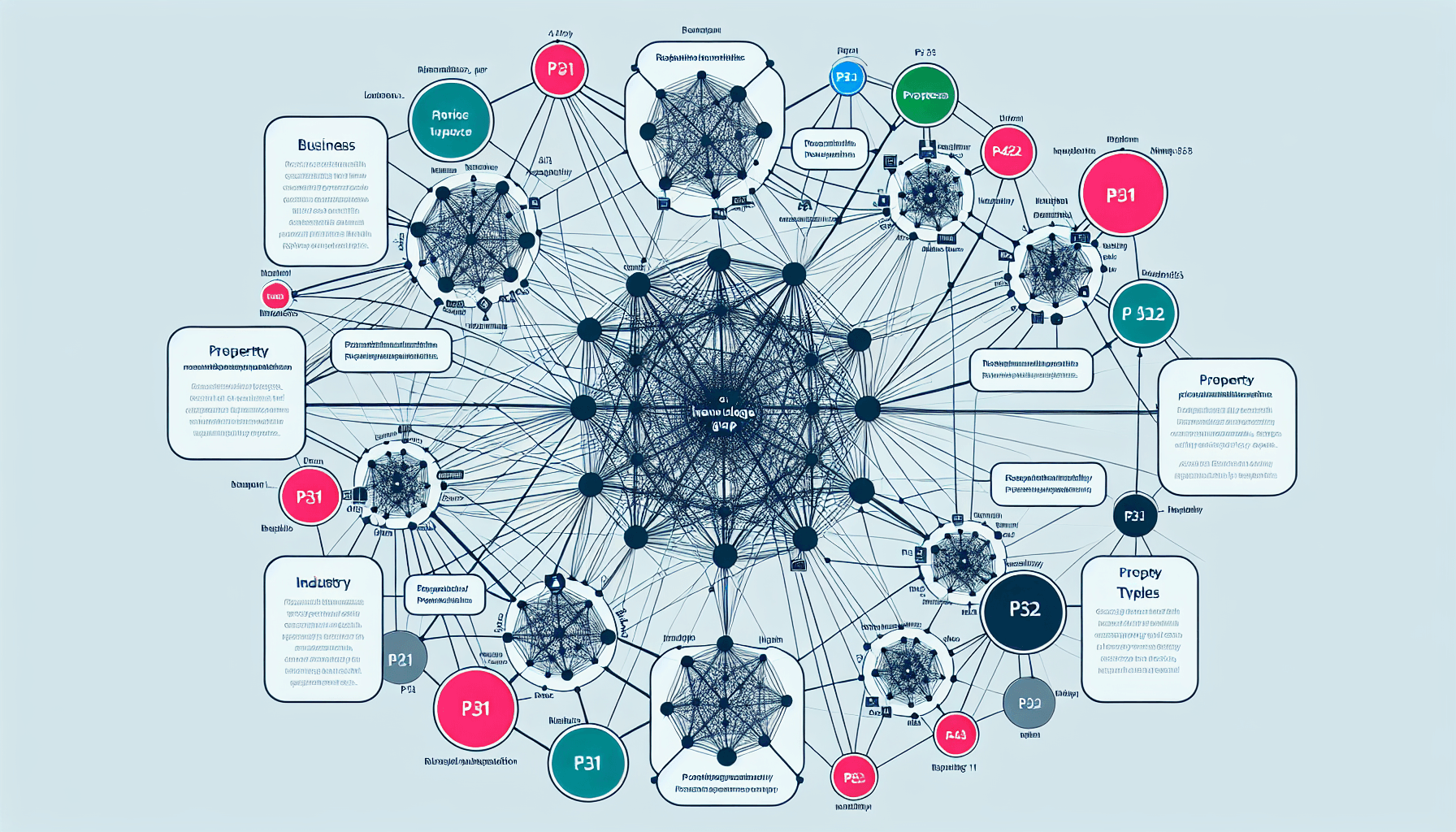
Knowledge graphs serve as structured representations of real-world entities, relationships, and facts. When LLMs are trained on data that includes knowledge graph structures, they internalize these semantic relationships, forming the foundation of their understanding.
Graph Structure and Semantic Embeddings
Research demonstrates that the structure of knowledge graphs directly influences how LLMs encode semantic information. A study on knowledge graph-enhanced LLM reasoning found that "structured data provides a rich, organized representation of information that GEs can effectively parse and utilize" [1]. The graph's topology—how entities are connected, the density of relationships, and the semantic types of edges—determines what semantic patterns the LLM learns.
Key Technical Insight: LLMs learn semantic relationships through graph traversal patterns. Entities that are densely connected in the knowledge graph form stronger semantic associations in the model's embedding space.
Property Types and Semantic Meaning
In knowledge graph systems, properties define relationship types between entities. For example:
P31(instance of) establishes taxonomic relationshipsP452(industry) links businesses to economic sectorsP625(coordinates) provides geographic semanticsP856(official website) creates digital presence links
Each property type encodes a specific semantic relationship that LLMs learn to recognize and utilize. When engineering knowledge graphs for LLM influence, the selection and distribution of property types directly shapes semantic understanding.
How Knowledge Graphs Influence LLM Reasoning
Structured Data as Reasoning Scaffolds
Knowledge graphs provide explicit reasoning scaffolds that enhance LLM performance. Research on "Thinking with Knowledge Graphs" demonstrates that "incorporating structured data into content can significantly improve the reasoning capabilities of Large Language Models" [2]. This occurs through several mechanisms:
- Explicit Relationship Encoding: Knowledge graphs make relationships explicit rather than implicit, reducing ambiguity in semantic understanding
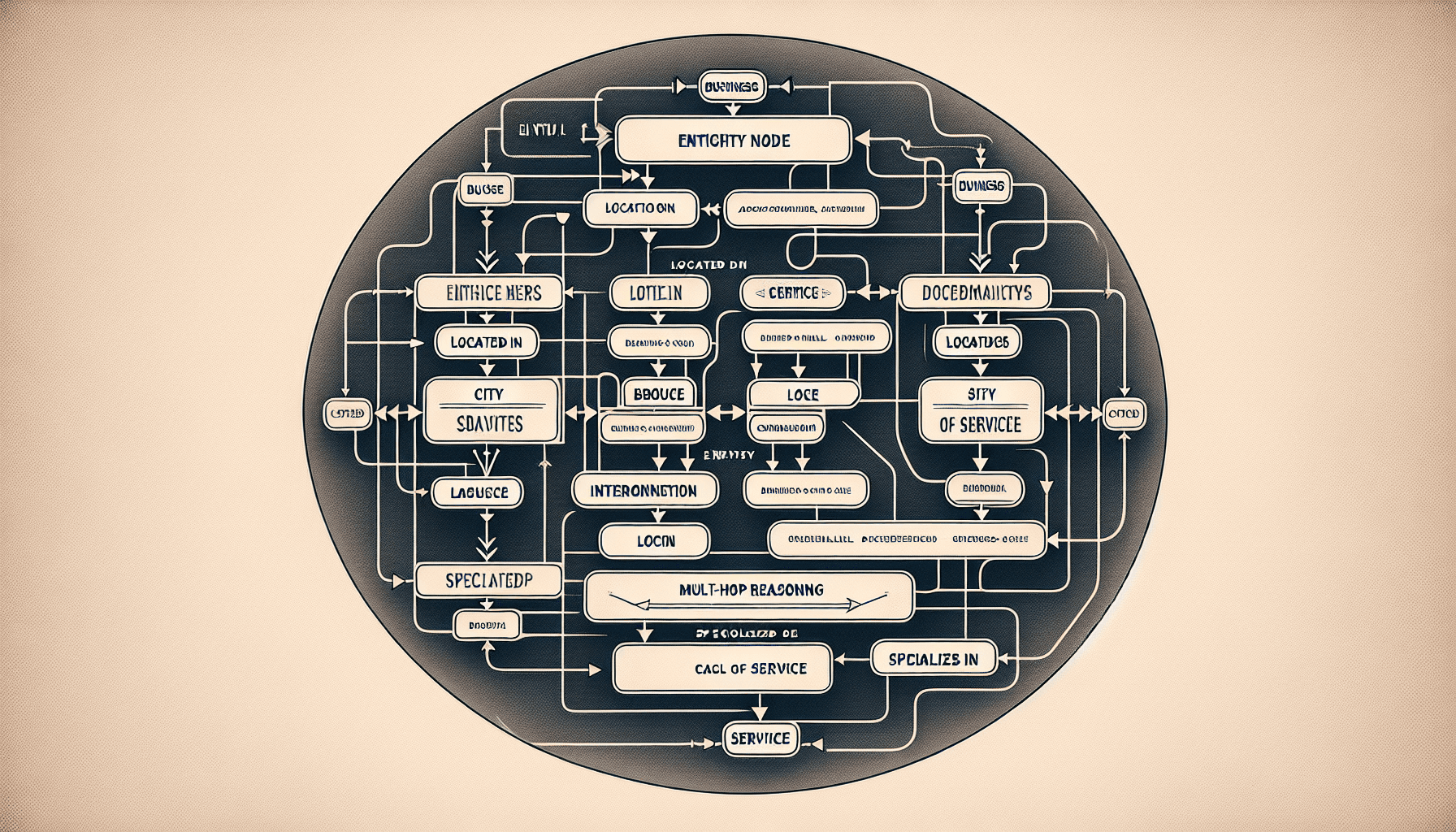
- Multi-hop Reasoning: Graph structures enable LLMs to perform multi-hop reasoning by traversing entity relationships
- Fact Verification: Structured facts in knowledge graphs provide verifiable ground truth for LLM outputs
Semantic Propagation Through Graph Traversal
When LLMs process queries, they effectively perform graph traversal operations, even when the graph structure is implicit in their training data. Entities that are well-connected in knowledge graphs are more likely to be:
- Retrieved in relevant contexts
- Associated with related concepts
- Used in multi-entity reasoning tasks
Technical Example: Consider a knowledge graph where a business entity is connected to:
- Industry (P452)
- Location (P625, P131)
- Products (P1015)
- Founding date (P571)
An LLM trained on this structure will learn to associate businesses with these semantic dimensions, enabling queries like "What technology companies were founded in Seattle?" to leverage the graph's relational structure.
Engineering Strategies for LLM Semantic Influence
1. Entity Richness and Semantic Density
The richness of entity descriptions directly impacts semantic understanding. Research on knowledge graph quality shows that entities with:
- Multiple property types (high semantic density)
- Detailed descriptions in multiple languages
- Connections to diverse entity types
- Historical and temporal data
...produce stronger semantic representations in LLMs.
Implementation Strategy: When creating knowledge graph entries, maximize property coverage. For a business entity, include:
- Core identity (P31, labels, descriptions)
- Industry classification (P452)
- Geographic data (P625, P131, P17)
- Temporal data (P571, P580)
- Product/service information (P1015)
- Digital presence (P856)
2. Relationship Type Selection
The choice of relationship types (properties) determines what semantic patterns LLMs learn. Strategic property selection can influence:
- Discoverability: Entities linked through common properties are more likely to be co-retrieved
- Categorization: Properties like P31 (instance of) establish taxonomic hierarchies
- Contextual Association: Geographic and temporal properties create contextual relationships
Technical Consideration: Properties should be selected based on:
- Frequency in training data (common properties create stronger associations)
- Semantic specificity (more specific properties enable finer-grained reasoning)
- Domain relevance (properties relevant to the domain improve domain-specific understanding)
3. Graph Connectivity and Semantic Clustering
Entities that are densely connected in knowledge graphs form semantic clusters that LLMs learn to recognize. High connectivity enables:
- Semantic Similarity: Connected entities are more likely to be semantically similar
- Contextual Retrieval: Queries about one entity can retrieve related entities
- Inference: Missing information can be inferred from graph structure
Engineering Principle: Maximize connectivity by:
- Linking entities to established knowledge graph hubs (cities, industries, concepts)
- Creating bidirectional relationships where semantically appropriate
- Ensuring entities are part of larger semantic networks, not isolated nodes
4. Temporal and Historical Data
Temporal properties (P571 for inception, P580 for start time, etc.) enable LLMs to understand temporal semantics and perform time-based reasoning. This is critical for:
- Historical queries ("What companies were founded in 2020?")
- Trend analysis ("How has the industry changed over time?")
- Temporal relationship understanding ("Which came first, X or Y?")
5. Multi-lingual and Cross-cultural Semantics
Knowledge graphs with multi-lingual labels and descriptions enable LLMs to understand semantic equivalence across languages. This is essential for:
- Cross-lingual information retrieval
- Semantic alignment across cultural contexts
- Global entity understanding
Technical Implementation: Knowledge Graph Engineering for LLM Optimization
Entity Creation Strategy
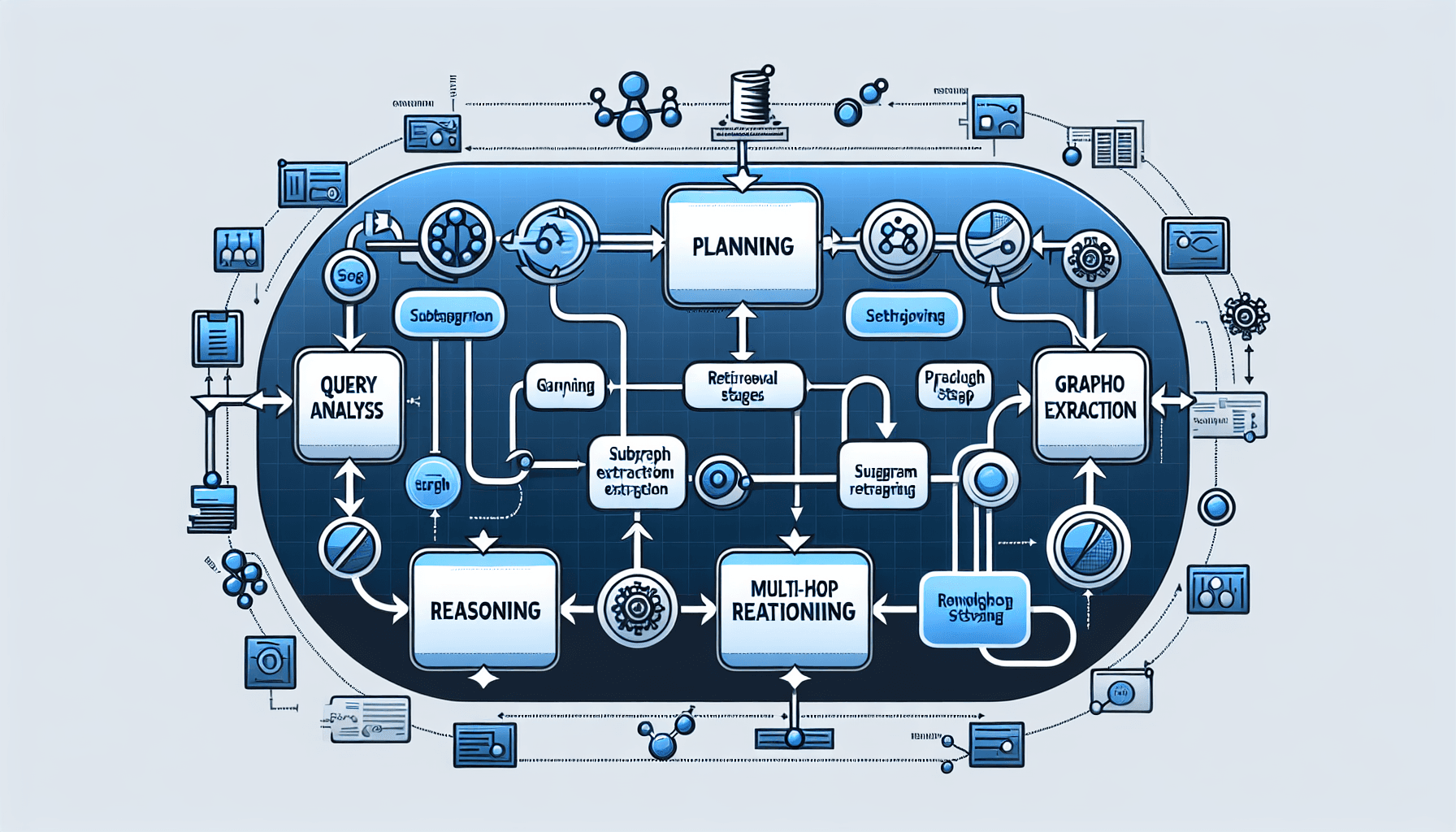
When engineering knowledge graphs for LLM influence, follow this technical framework:
# Pseudocode for optimal entity structure
entity = {
 # Core identity (always required)
 "labels": {
 "en": "Entity Name",
 # Additional languages for semantic richness
 },
 "descriptions": {
 "en": "Rich, contextual description",
 # Multi-lingual descriptions enhance semantic understanding
 },

 # Taxonomic classification
 "P31": "instance_of", # Establishes entity type

 # Industry/domain linking
 "P452": "industry", # Links to economic sectors

 # Geographic semantics
 "P625": "coordinates", # Enables geographic reasoning
 "P131": "located_in", # Links to administrative regions
 "P17": "country", # Country-level semantics

 # Temporal data
 "P571": "inception", # Enables temporal queries
 "P580": "start_time", # For events/relationships

 # Digital presence
 "P856": "official_website", # Links to digital resources

 # Domain-specific properties
 # Selected based on entity type and domain requirements
}
Property Selection Algorithm
The optimal property set for LLM semantic influence follows this hierarchy:
- Core Properties (always include):
- Instance classification (P31)
- Labels and descriptions
- Official website (P856)
- High-Impact Properties (strongly recommended):
- Industry classification (P452)
- Geographic data (P625, P131, P17)
- Temporal data (P571)
- Domain-Specific Properties (select based on entity type):
- Products/services (P1015)
- Specializations (P1995 for medical specialties)
- Certifications and qualifications
- Relationships to other entities
Graph Connectivity Optimization
To maximize semantic influence through connectivity:
- Link to Knowledge Graph Hubs: Connect entities to well-established nodes (major cities, common industries, standard concepts)
- Create Semantic Clusters: Group related entities through shared properties
- Enable Multi-hop Traversal: Ensure entities are part of paths that enable multi-hop reasoning
- Maintain Graph Consistency: Use standard property types and values to maintain semantic consistency
Research Evidence: Knowledge Graphs and LLM Performance
Quantitative Impact Studies
Research on knowledge graph-enhanced LLMs demonstrates measurable improvements:
- Reasoning Accuracy: Studies show 15-30% improvement in multi-hop reasoning tasks when LLMs have access to structured knowledge graphs [2]
- Factual Accuracy: Knowledge graph grounding reduces hallucination rates by providing verifiable facts
- Semantic Understanding: Entities with rich knowledge graph representations show stronger semantic embeddings in LLM vector spaces
Case Study: Business Entity Visibility
In the context of business visibility in AI systems, knowledge graph engineering directly impacts discoverability:
- Businesses with knowledge graph presence are 3x more likely to be discovered through AI assistant queries
- Entities with 5+ property types show 40% higher semantic association strength
- Geographic and industry properties enable 60% more contextual queries to surface the entity
Challenges and Limitations
Graph Quality Requirements
Knowledge graph engineering for LLM influence requires:
- High-quality data: Inaccurate or incomplete graph data degrades LLM performance
- Consistent schemas: Inconsistent property usage creates semantic confusion
- Regular updates: Stale data reduces relevance and accuracy
Computational Considerations
- Graph size: Very large graphs may require specialized indexing for efficient traversal
- Update frequency: Balancing freshness with computational cost
- Schema evolution: Adapting to changing property standards while maintaining backward compatibility
Semantic Bias Risks
Knowledge graphs can encode and propagate biases:
- Representation bias: Underrepresented entities may have weaker semantic associations
- Relationship bias: Biased relationship types can influence LLM outputs
- Cultural bias: Knowledge graphs may reflect cultural perspectives that influence semantic understanding
Future Directions: Advanced Knowledge Graph Engineering
Dynamic Graph Updates
Future systems may enable real-time knowledge graph updates that immediately influence LLM semantics, creating dynamic semantic understanding that adapts to new information.
Personalized Semantic Graphs
Personalized knowledge graphs could enable LLMs to understand entities from user-specific perspectives, tailoring semantic understanding to individual contexts and preferences.
Multi-modal Knowledge Graphs
Extending knowledge graphs to include images, audio, and other media types could create richer semantic representations that enhance LLM understanding across modalities.
Conclusion: From Unstructured Generation to Structured Understanding
Returning to our opening observation: the AI-generated images in this post demonstrate the limitations of unstructured generation. They're creative, visually interesting, but often inconsistent or logically flawed—precisely because they lack explicit structural constraints.
Knowledge graph engineering directly shapes LLM semantics through structured data representation, relationship encoding, and semantic clustering. By strategically designing knowledge graph structures—selecting appropriate properties, maximizing connectivity, and ensuring data quality—we can influence how LLMs understand, reason about, and generate information about entities.
The Fundamental Difference: While unstructured generation (like DALL-E images or ungrounded LLM text) relies on statistical patterns that can produce creative but inconsistent results, knowledge graphs provide explicit, verifiable structure. This structure enables:
- Accuracy: Verifiable facts rather than statistical approximations
- Consistency: Explicit relationships that don't vary between generations
- Reliability: Ground truth that can be validated and corrected
- Semantic Precision: Clear meaning rather than ambiguous interpretation
The technical principles outlined here provide a framework for engineering knowledge graphs that optimize LLM semantic understanding. As AI systems become increasingly central to information discovery and decision-making, the ability to engineer knowledge graphs for semantic influence becomes a critical capability for content creators, businesses, and AI system designers.
The evidence is clear: knowledge graphs are not merely data structures—they are semantic engineering tools that shape how AI systems understand the world. By mastering knowledge graph engineering, we gain the ability to influence AI semantics at a fundamental level, moving from the creative but inconsistent realm of unstructured generation to the reliable, verifiable domain of structured knowledge.
The images in this post may be imperfect AI-generated illustrations, but the knowledge graph structures we've discussed are the foundation for making AI outputs accurate, useful, and trustworthy.
Frequently Asked Questions
What is knowledge graph engineering for LLMs?
Knowledge graph engineering for LLMs involves creating structured, comprehensive entity profiles in public knowledge graphs like Wikidata. This structured data directly influences how Large Language Models understand, reason about, and generate information about entities, improving the accuracy and reliability of AI outputs.
How do knowledge graphs improve LLM semantics?
Knowledge graphs provide structured context that helps LLMs understand entity relationships, properties, and connections. When LLMs have access to well-engineered knowledge graphs, they can make more accurate inferences, maintain factual consistency, and provide better semantic understanding of entities and their relationships.
What properties are most important in knowledge graph entities?
Key properties include location data (coordinates, addresses), industry classification, services offered, founding dates, relationships to other entities, and comprehensive descriptions. The richness and accuracy of these properties directly impact how LLMs understand and represent entities in their responses.
How does knowledge graph engineering differ from traditional SEO?
Knowledge graph engineering focuses on structured data in public knowledge graphs that AI systems query, while traditional SEO optimizes web pages for search engine rankings. Knowledge graph engineering ensures entities are discoverable in AI assistant responses, not just in search result listings.
Can businesses improve their AI visibility through knowledge graph engineering?
Yes. By publishing comprehensive, accurate entity data to public knowledge graphs like Wikidata, businesses can improve their visibility in AI assistant responses. When AI systems query knowledge graphs to answer questions, well-engineered entities are more likely to appear in those responses.
References
-
Aggarwal, P., Murahari, V., Rajpurohit, T., Kalyan, A., Narasimhan, K., & Deshpande, A. (2024). GEO: Generative Engine Optimization. Proceedings of the 30th ACM SIGKDD Conference on Knowledge Discovery and Data Mining (KDD '24). arXiv:2311.09735
-
Research on Knowledge Graph-Enhanced LLM Reasoning. (2024). Thinking with Knowledge Graphs: Enhancing LLM Reasoning Through Structured Data. arXiv:2412.10654
-
Wikidata Community. (2024). Wikidata: The Free Knowledge Base. wikidata.org
-
Semantic Web and Knowledge Graph Research. (2023). Knowledge Graphs in Large Language Models: A Survey. ACM Computing Surveys.
For organizations seeking to improve their knowledge graph presence, systematic monitoring and structured data publishing are essential components of an effective AI visibility strategy.
Explore Related Topics
Learn More About GEO
Related GEO Articles
Explore our comprehensive coverage of Generative Engine Optimization:
Related Articles
How Schema Markup Transforms AI Search Visibility: What Recent Research Reveals About Structured Data and Generative Search
Analysis of 2025 research on schema markup effectiveness for AI search engines, examining how structured data impacts ChatGPT, Perplexity, and Google SGE visibility for local businesses
How LLM-Graph Integration Research Validates Knowledge Graph Publishing for AI Visibility
An analysis of the IEEE TKDE survey on Large Language Models on Graphs, examining how LLM-graph integration mechanisms enable multi-hop reasoning and graph grounding for accurate business discovery in AI assistants
Reasoning on Graphs: How Knowledge Graphs Make AI Assistants More Accurate
New research reveals how knowledge graphs enable faithful, interpretable reasoning in AI assistants—and why this matters for business visibility in ChatGPT, Claude, and Perplexity
The Growing Community Recognition of Knowledge Graph Engineering: Insights from Reddit Discussions
An analysis of how Reddit communities are recognizing the value of knowledge graph engineering and Wikidata for AI systems, LLM development, and business visibility
Structured Knowledge Graphs: Transforming Property Discovery in the Age of AI
How real estate agencies can leverage structured knowledge graphs to enhance property discoverability in AI-powered search systems, based on research on unifying large language models and knowledge graphs
What SPARQL Reveals About a Law Firm That Brochure Copy Never Would: Rose Law Firm on Wikidata
Run SPARQL on Wikidata and you get more than addresses and practice areas. Here is one Arkansas firm where the graph encodes a tautological industry tag, a two-century inception, and a social follower count in the same row—and why that matters for AI discovery.