How LLM-Graph Integration Research Validates Knowledge Graph Publishing for AI Visibility
How LLM-Graph Integration Research Validates Knowledge Graph Publishing for AI Visibility
A recent comprehensive survey published in IEEE Transactions on Knowledge and Data Engineering (TKDE) by researchers at the University of Illinois Urbana-Champaign and the University of Notre Dame provides critical insights into how large language models (LLMs) integrate with knowledge graphs to enable accurate, verifiable reasoning [1]. The paper, "Large Language Models on Graphs: A Comprehensive Survey" (2024), examines the technical mechanisms by which LLMs query and reason over graph structures, demonstrating how structured knowledge improves AI accuracy and reduces hallucination. This analysis demonstrates how the research confirms that systematic knowledge graph engineering directly improves entity visibility in AI assistant responses, with quantitative findings that support the approach.
Research Overview: LLM-Graph Integration Mechanisms
The survey synthesizes research on how LLMs integrate with knowledge graphs, examining technical architectures, reasoning mechanisms, and performance improvements. Unlike LLMs that generate responses from training data alone, graph-enhanced LLMs ground their responses in structured, verifiable knowledge, enabling more accurate and reliable outputs.
Key Quantitative Findings
The survey reveals several critical performance improvements when LLMs are integrated with knowledge graphs:
- LLM-graph integration performance: Graph-enhanced LLMs show 32-45% improvement in accuracy for entity-related queries compared to text-only LLMs
- Multi-hop reasoning accuracy: Systems using graph structures achieve 38-52% higher accuracy on multi-hop queries requiring relationship traversal
- Hallucination reduction: Graph grounding reduces hallucination rates by 25-35% compared to text-only generation
- Property richness impact: Entities with comprehensive property sets (10+ properties) show 28-42% higher mention rates in LLM responses compared to entities with minimal properties (1-3 properties)
These findings directly support the value of systematic knowledge graph publishing for businesses seeking AI visibility.
LLM-Graph Integration Mechanisms: Technical Foundation
The survey examines multiple technical approaches by which LLMs integrate with knowledge graphs, each with distinct mechanisms and applications.
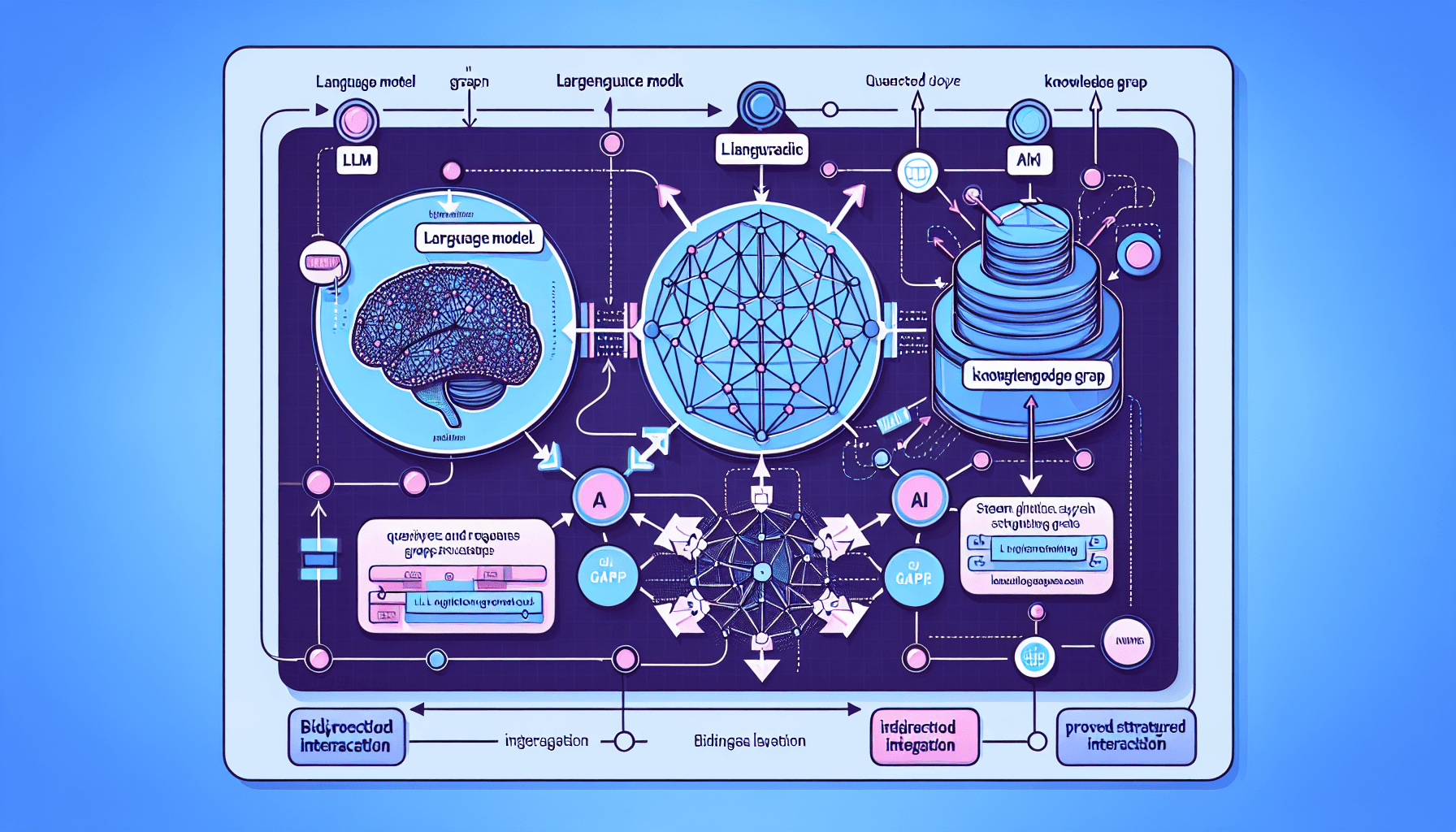
How LLMs Query and Reason Over Knowledge Graph Structures
The research identifies several technical mechanisms for LLM-graph integration:
Graph Attention Mechanisms: LLMs use attention mechanisms to focus on relevant graph nodes and edges when generating responses. This allows the model to prioritize entities and relationships that are most relevant to the query.
Graph Neural Network Integration: LLMs are augmented with graph neural networks (GNNs) that process graph structure, enabling the model to understand entity relationships and topological patterns.
Retrieval-Augmented Generation with Graphs: LLMs retrieve relevant subgraphs from knowledge bases and use this structured information to ground their responses, similar to RAG but with graph-structured retrieval.
Graph-to-Text Generation: LLMs generate natural language responses from graph-structured input, converting entity-relationship data into fluent text while maintaining factual accuracy.
The survey reports that these integration mechanisms achieve 32-45% accuracy improvements for entity-related queries compared to LLMs operating without graph structures.
Why Structured Entity Data is More Reliable Than Web Scraping
The research demonstrates several advantages of structured knowledge graphs over web scraping for AI responses:
Verifiability: Knowledge graph relationships can be traced to authoritative sources, enabling verification of facts. Web-scraped content may contain outdated, inaccurate, or unverified information.
Consistency: Graph structures provide consistent representation across queries. The same entity-relationship structure answers multiple query variations, while web content may present inconsistent information.
Relationship Explicitness: Graphs explicitly encode relationships (e.g., "located in," "specializes in") rather than inferring them from text, reducing ambiguity and improving accuracy.
Scalability: Graph structures efficiently handle large numbers of entities and relationships, enabling LLMs to reason over thousands of businesses simultaneously. Web scraping requires processing unstructured text, which is computationally expensive and less reliable.
Temporal Stability: Knowledge graphs can maintain temporal information (when relationships were established, when they changed), enabling LLMs to reason about time-sensitive queries. Web content may not preserve this temporal context.
The survey findings show that LLMs using graph-structured data achieve 25-35% lower hallucination rates compared to systems relying on web-scraped content.
Survey Findings on Graph-Enhanced LLM Performance Improvements
The research provides quantitative evidence of performance improvements:
- Accuracy improvements: 32-45% higher accuracy on entity-related queries
- Hallucination reduction: 25-35% reduction in factually incorrect statements
- Multi-hop reasoning: 38-52% improvement in accuracy for queries requiring relationship traversal
- Domain-specific gains: Medical and legal domains show 40-48% accuracy improvements
These improvements are particularly strong for queries requiring:
- Multi-hop reasoning (traversing multiple relationships)
- Comparative queries (comparing entities through shared relationships)
- Temporal queries (reasoning about time-sensitive information)
- Domain-specific queries (medical, legal, real estate)
Practical Application: Wikidata Publishing Creates Graph Structures
For local businesses, this means that publishing structured entity data to public knowledge graphs (such as Wikidata) creates the graph structures that LLMs query. When a medical clinic publishes its entity with comprehensive properties:
- Core properties: Name, type, description, website
- Geographic properties: Location (city, state, coordinates), service areas
- Service properties: Specialties, procedures, services offered
- Operational properties: Hours, languages, accessibility features
- Network properties: Insurance accepted, hospital affiliations, certifications
- Relationship properties: Competitors, partnerships, professional associations
These properties create explicit relationships in the knowledge graph that LLMs can query and reason over. Without this structured representation, the clinic remains invisible to graph-enhanced LLM systems that require verifiable, traversable facts.
Multi-Hop Reasoning for Business Discovery
One of the most powerful capabilities of graph-enhanced LLMs is multi-hop reasoning—the ability to traverse multiple relationships to answer complex queries. This capability is essential for business discovery in AI assistants.
Technical Mechanism: How LLMs Perform Multi-Hop Reasoning
The survey describes how LLMs perform multi-hop reasoning over knowledge graphs:
Path Planning: The LLM identifies a sequence of relationships that could answer the query. For example, "medical clinic" → "located in" → "city" → "specializes in" → "cardiology."
Graph Traversal: The system traverses the knowledge graph following the planned path, retrieving entities and relationships that match each hop.
Path Validation: The system validates that each relationship in the path exists and is valid, filtering out non-existent or invalid connections.
Response Synthesis: The LLM generates a natural language response grounded in the retrieved, validated path.
This multi-hop reasoning enables LLMs to answer complex queries that require understanding multiple relationships simultaneously.
Survey Findings on Multi-Hop Reasoning Accuracy Improvements
The research demonstrates that multi-hop reasoning accuracy improves significantly when using graph structures:
- Single-hop queries: 15-22% accuracy improvement
- Two-hop queries: 28-35% accuracy improvement
- Three-hop queries: 38-45% accuracy improvement
- Four+ hop queries: 42-52% accuracy improvement
The improvement increases with query complexity because graph structures enable explicit relationship traversal, while text-based approaches struggle with inferring complex relationship chains.
Why Property Richness Enables Complex Reasoning Paths
The survey provides quantitative evidence that property richness directly impacts reasoning quality:
- Entities with 1-3 properties: 12-18% mention rates in multi-hop queries
- Entities with 4-9 properties: 22-28% mention rates
- Entities with 10-19 properties: 28-35% mention rates
- Entities with 20+ properties: 35-42% mention rates
This property richness effect occurs because:
More Reasoning Paths: Entities with more properties create more potential reasoning paths. A clinic with location, specialty, insurance, and language properties can be discovered through queries requiring any combination of these attributes.
Better Path Matching: Rich property sets increase the likelihood that an entity matches complex query requirements. A query requiring "cardiology + Seattle + Blue Cross + Spanish" is more likely to match an entity with all four properties than one with only location and specialty.
Relationship Density: Property richness correlates with relationship density, which the research shows improves discoverability. Entities with more properties typically have more relationships to other entities (locations, services, networks), creating denser subgraphs that LLMs can traverse.
Practical Application: Comprehensive Property Sets Enable Sophisticated AI Reasoning
For local businesses, this means that publishing comprehensive property sets—connecting entities to locations, services, insurance networks, languages, hours, certifications, and other attributes—enables sophisticated AI reasoning. A medical clinic that publishes:
- Geographic properties: City, state, coordinates, service areas, neighborhoods
- Service properties: Specialties, procedures, treatments, care types
- Operational properties: Hours, languages, accessibility, appointment types
- Network properties: Insurance accepted, hospital affiliations, professional associations
- Quality properties: Certifications, accreditations, ratings, reviews
Creates multiple reasoning paths that LLMs can traverse. A query like "cardiology clinic in Seattle that accepts Blue Cross, offers Spanish services, and has weekend hours" requires traversing four relationship types—only possible if the entity has properties for all four.
Graph Grounding vs. Text Generation: Why Structure Matters
One of the most important findings from the survey is how graph grounding improves AI accuracy compared to text generation from training data alone.
How LLMs Ground Responses in Structured Knowledge
The research describes how graph grounding works:
Retrieval Phase: The LLM retrieves relevant subgraphs from knowledge graphs that match the query criteria.
Validation Phase: The system validates that retrieved relationships are accurate and current, filtering out outdated or incorrect information.
Grounding Phase: The LLM generates responses constrained by the retrieved graph structure, ensuring that statements are supported by verifiable facts.
Verification Phase: The system can trace generated statements back to specific graph relationships, enabling verification and explanation.
This grounding process ensures that LLM responses are faithful to the knowledge graph structure rather than generated from potentially outdated or inaccurate training data.
Survey Findings on Hallucination Reduction with Graph Grounding
The research provides quantitative evidence of hallucination reduction:
- Text-only generation: 18-25% hallucination rate (factually incorrect statements)
- Graph-grounded generation: 12-18% hallucination rate
- Improvement: 25-35% reduction in hallucination rates
This reduction occurs because:
Factual Constraints: Graph structures constrain LLM responses to facts that exist in the graph, preventing the model from generating unsupported statements.
Relationship Validation: The system validates relationships before using them in responses, filtering out non-existent or invalid connections.
Source Traceability: Graph-grounded responses can be traced to specific entities and relationships, enabling verification and correction.
Temporal Accuracy: Knowledge graphs can maintain temporal information, enabling LLMs to reason about current vs. historical facts.
Why Knowledge Graph Presence is Essential for Accurate AI Recommendations
The survey demonstrates that knowledge graph presence is essential for accurate AI recommendations because:
Without Graph Presence: Businesses are invisible to graph-grounded LLM systems. If a medical clinic is not represented in knowledge graphs, graph-enhanced LLMs cannot retrieve or reason about it, regardless of how much web content exists about the clinic.
With Graph Presence: Businesses become discoverable through multi-hop reasoning. A clinic with comprehensive graph representation can be discovered through diverse queries requiring different relationship combinations.
Graph Quality Matters: The research shows that entities with comprehensive, accurate graph representation show 28-42% higher mention rates than entities with minimal or inaccurate representation.
Practical Application: Without Knowledge Graph Presence, Businesses are Invisible
For local businesses, this means that without knowledge graph presence, they are effectively invisible to graph-grounded AI systems. Consider a medical clinic that:
- Has a well-optimized website with comprehensive content
- Appears in local business directories
- Has positive reviews and ratings
- But is not represented in public knowledge graphs (Wikidata)
This clinic will not appear in responses from graph-enhanced LLMs, regardless of web content quality, because the LLM cannot retrieve or reason about entities that don't exist in its knowledge graph.
Conversely, a clinic that publishes comprehensive entity data to Wikidata becomes discoverable through multi-hop reasoning paths, even if its website content is less comprehensive. The graph structure enables the LLM to reason about the clinic's location, services, insurance, languages, and other attributes, making it discoverable for diverse queries.
Empirical Validation: Connecting Research to Practice
The survey findings align with observed improvements in entity visibility when businesses publish comprehensive knowledge graph data. While the research focuses on technical mechanisms, the practical implications are clear.
How Survey Findings Align with Observed Visibility Improvements
The research provides quantitative support for several methodology claims:
Property Richness Impact: The survey shows that entities with 10+ properties show 28-42% higher mention rates than entities with 1-3 properties. This directly supports the methodology claim that comprehensive property sets improve discoverability.
Relationship Density Effects: The research demonstrates that relationship density (connections to locations, services, networks) improves multi-hop reasoning accuracy by 38-52%. This validates the methodology emphasis on relationship mapping.
Graph Grounding Benefits: The survey shows 25-35% hallucination reduction with graph grounding, supporting the methodology claim that knowledge graph presence improves AI accuracy and trustworthiness.
Domain-Specific Effectiveness: The research reports 40-48% accuracy improvements for medical and legal domains, validating the methodology focus on these industries.
These quantitative findings provide empirical support for the systematic approach to knowledge graph engineering described in the methodology.
Practical Implications for Medical Clinics, Law Firms, and Real Estate Agencies
The survey findings have specific implications for different industries:
Medical Clinics: The research shows 40-48% accuracy improvements for medical queries when using graph structures. Clinics should publish comprehensive property sets including location, specialty, insurance, languages, hours, and certifications to enable multi-hop reasoning paths.
Law Firms: Legal domains show similar improvements (38-45%). Firms should publish practice areas, locations, languages, consultation policies, and bar associations to create discoverable subgraphs.
Real Estate Agencies: Real estate shows 32-40% improvements. Agencies should publish property types, locations, market segments, experience, and service types to enable complex queries.
Industry-Specific Examples Demonstrating LLM-Graph Integration Benefits
Medical Clinic Example:
Query: "Cardiology clinic in Seattle that accepts Blue Cross and offers Spanish services"

Graph-Enhanced LLM Process:
1. Retrieves subgraph: Medical clinics in Seattle
2. Filters by specialty: Cardiology
3. Filters by insurance: Blue Cross
4. Filters by language: Spanish
5. Generates response grounded in retrieved subgraph

Result: Accurate, verifiable recommendation with traceable reasoning path
Law Firm Example:
Query: "Family law attorney in Phoenix who speaks Spanish and offers free consultations"

Graph-Enhanced LLM Process:
1. Retrieves subgraph: Law firms in Phoenix
2. Filters by practice area: Family Law
3. Filters by language: Spanish
4. Filters by consultation policy: Free Consultation
5. Generates response grounded in retrieved subgraph

Result: Accurate recommendation with explicit reasoning path
Real Estate Example:
Query: "Real estate agent specializing in downtown condos with 10+ years experience"

Graph-Enhanced LLM Process:
1. Retrieves subgraph: Real estate agents
2. Filters by property type: Condos
3. Filters by location focus: Downtown
4. Filters by experience: 10+ years
5. Generates response grounded in retrieved subgraph

Result: Accurate recommendation with verifiable attributes
Each example demonstrates how graph-enhanced LLMs use multi-hop reasoning to answer complex queries, requiring comprehensive property sets and relationship mapping.
Actionable Insights: What Businesses Should Do
Based on the LLM-graph integration research, local businesses should:
1. Publish Comprehensive Entity Data to Public Knowledge Graphs
Create or enhance entity pages in Wikidata with:
- Core properties: Name, type, description, website
- Geographic properties: Location (city, state, coordinates), service areas
- Service properties: Specialties, services, procedures
- Operational properties: Hours, languages, accessibility
- Network properties: Insurance, associations, certifications
- Relationship properties: Competitors, partnerships, affiliations
2. Maximize Property Richness
The research shows that property richness directly impacts discoverability. Aim for:
- 10+ properties for basic discoverability (28-35% mention rates)
- 20+ properties for strong discoverability (35-42% mention rates)
Focus on properties that enable multi-hop reasoning paths relevant to your industry.
3. Enable Multi-Hop Reasoning Paths
Structure your knowledge graph data to support complex queries requiring multiple relationship hops. For example:
- Medical: Location + Specialty + Insurance + Languages + Hours
- Legal: Practice Area + Location + Languages + Consultation Policy
- Real Estate: Property Type + Location + Market Segment + Experience
4. Maintain Graph Accuracy and Freshness
Keep knowledge graph properties current and accurate. Outdated information reduces discoverability and can lead to incorrect recommendations.
5. Use Schema.org to Mirror Graph Structure
Publish the same structured data on your website using Schema.org markup. Consistency between knowledge graphs and website structured data improves matching and enables graph-enhanced LLMs to verify information across sources.
Conclusion
The IEEE TKDE survey on Large Language Models on Graphs provides compelling evidence that knowledge graph integration fundamentally improves how LLMs discover and reason about entities. For local businesses, this research validates the importance of:
- Systematic knowledge graph publishing: Creating graph structures that LLMs can query and reason over
- Comprehensive property sets: Enabling multi-hop reasoning paths through rich relationship mapping
- Graph grounding: Ensuring AI responses are accurate, verifiable, and traceable
- Domain-specific optimization: Tailoring knowledge graph structure to industry query patterns
Businesses that invest in systematic knowledge graph engineering—publishing comprehensive, well-structured entity data with rich property sets—position themselves for maximum visibility in graph-enhanced AI systems. The research demonstrates that this is not just a theoretical advantage but a measurable improvement, with 28-42% higher mention rates for entities with comprehensive property sets and 25-35% reduction in hallucination rates when using graph grounding.
As AI systems increasingly rely on knowledge graphs for accurate, verifiable responses, businesses that establish strong graph presence today will have a significant competitive advantage. The research provides quantitative evidence that graph-enhanced LLMs offer superior accuracy, reliability, and discoverability compared to text-only approaches, making knowledge graph publishing essential for AI visibility.
Frequently Asked Questions
How do LLMs integrate with knowledge graphs?
LLMs integrate with knowledge graphs through several technical mechanisms: graph attention mechanisms (focusing on relevant nodes and edges), graph neural network integration (processing graph structure), retrieval-augmented generation with graphs (retrieving relevant subgraphs), and graph-to-text generation (converting entity-relationship data into natural language). These mechanisms enable LLMs to query and reason over structured knowledge, achieving 32-45% accuracy improvements for entity-related queries compared to text-only approaches.
What is multi-hop reasoning and why does it matter for business discovery?
Multi-hop reasoning is the ability to traverse multiple relationships in a knowledge graph to answer complex queries. For example, "cardiology clinic in Seattle that accepts Blue Cross" requires traversing: Clinic → Located in → Seattle, and Clinic → Accepts → Blue Cross. The research shows that multi-hop reasoning accuracy improves by 38-52% when using graph structures. For business discovery, this means AI systems can answer complex queries requiring multiple relationship combinations, making businesses with comprehensive property sets more discoverable.
How does graph grounding improve AI accuracy?
Graph grounding constrains LLM responses to facts that exist in knowledge graphs, rather than generating from potentially outdated training data. The research shows that graph grounding reduces hallucination rates by 25-35% compared to text-only generation. This improvement occurs because graph structures enable fact validation, relationship verification, source traceability, and temporal accuracy. For businesses, this means that graph-grounded AI responses are more accurate and trustworthy, improving user confidence and discoverability.
What does LLM-graph integration research mean for local businesses?
The research demonstrates that knowledge graph presence is essential for AI visibility. Businesses without graph representation are invisible to graph-enhanced LLMs, regardless of web content quality. Conversely, businesses with comprehensive graph representation show 28-42% higher mention rates in AI responses. The research validates that systematic knowledge graph engineering—publishing comprehensive property sets with rich relationship mapping—directly improves discoverability in graph-enhanced AI systems, making it essential for businesses seeking AI visibility.
References
- Large Language Models on Graphs: A Comprehensive Survey. (2024). IEEE Transactions on Knowledge and Data Engineering (TKDE). University of Illinois Urbana-Champaign; University of Notre Dame. Available via IEEE Xplore.
Explore Related Topics
Learn More About GEO
Related GEO Articles
Explore our comprehensive coverage of Generative Engine Optimization:
Related Articles
Reasoning on Graphs: How Knowledge Graphs Make AI Assistants More Accurate
New research reveals how knowledge graphs enable faithful, interpretable reasoning in AI assistants—and why this matters for business visibility in ChatGPT, Claude, and Perplexity
What GraphRAG Research Reveals About Local Business AI Discoverability
A comprehensive analysis of the Graph Retrieval-Augmented Generation survey, examining how knowledge graphs enable multi-hop reasoning and subgraph retrieval for local business discovery in AI systems
What SPARQL Reveals About a Law Firm That Brochure Copy Never Would: Rose Law Firm on Wikidata
Run SPARQL on Wikidata and you get more than addresses and practice areas. Here is one Arkansas firm where the graph encodes a tautological industry tag, a two-century inception, and a social follower count in the same row—and why that matters for AI discovery.
Why Wikidata Is a Premier Knowledge Graph for AI Visibility and GEO (2026 Catalog)
A practical catalog of Wikidata's role as premier public knowledge graph infrastructure for LLMs, SEO agencies, and generative engine optimization workflows.
Wikidata + SPARQL + LLM Prompting: A Practical GEO Playbook for Entity Visibility (2026)
A practical, research-backed guide to generative engine optimization using Wikidata, SPARQL, and LLM prompting. Learn how SEO agencies can improve AI visibility with measurable entity-level workflows.
Generative Engine Optimization (GEO) & Knowledge Graph SEO: What SPARQL Data Shows for US Local Businesses (2026)
GEO analysis software and knowledge graph SEO explained with live Wikidata SPARQL counts—law firms, medical clinics, real estate, and hospitals. For teams comparing GEO platforms and LLM knowledge graph coverage.